Latehar: Four advanced filariasis patients get tricycles to improve mobility
THE JHARKHAND STORY NETWORK Daltonganj, September 28: Four patients suffering from advanced lymphatic filariasis in Latehar have been provided tricycles to help…
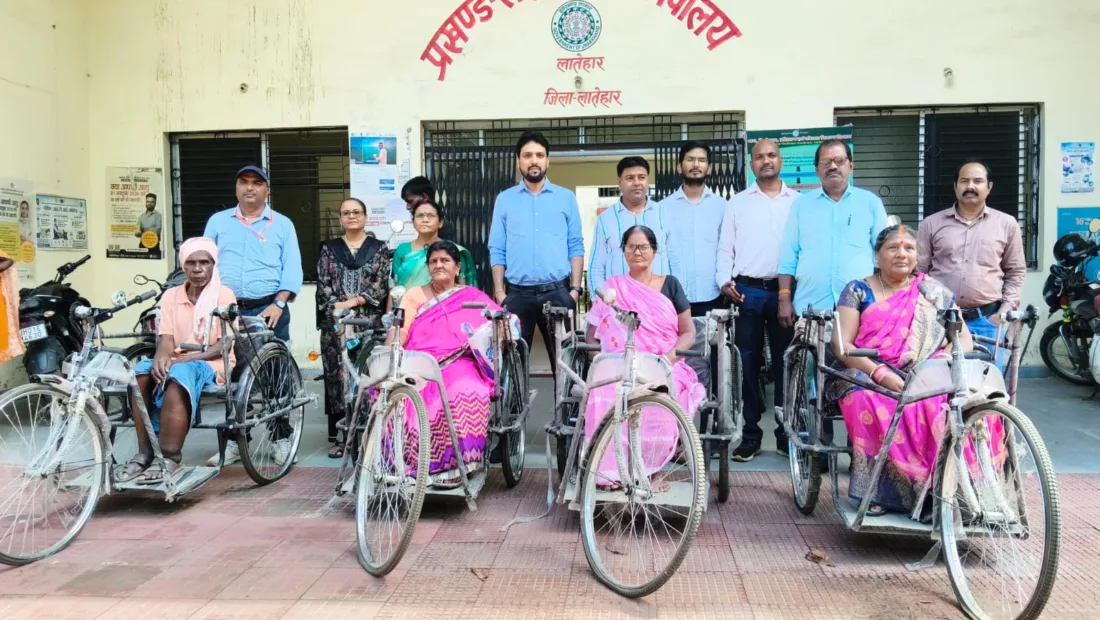
Filariasis patients receiving tricycles in Latehar recently.
THE JHARKHAND STORY NETWORK
Daltonganj, September 28: Four patients suffering from advanced lymphatic filariasis in Latehar have been provided tricycles to help them overcome severe mobility difficulties caused by the disease.

The initiative was taken following directions from Latehar Deputy Commissioner Sandip Kumar, who asked the Social Welfare Department to identify filariasis patients facing acute mobility challenges and provide them with suitable support.
The four beneficiaries—Usan Bhuiyan, Amrawati Devi, Manti Devi and Pushpa Devi—all from Sadar block of Latehar—received the tricycles at the Block-cum-Anchal Office premises in Sadar Latehar late on Saturday.
According to District Programme Manager (Health) N.K. Das, all four patients are suffering from Grade VII filariasis, an advanced stage in which swelling becomes irreversible, skin folds deepen and the skin develops a thick, leathery texture.
“Swelling is not reversible. Skin folds are deep and the skin becomes leathery,” Das said, explaining the condition of Grade VII patients.

In advanced lymphatic filariasis, mobility can become severely restricted, making routine activities such as walking and even going to the toilet extremely difficult.
Latehar currently has more than 1,180 active filariasis cases, according to health officials. Of these, around 813 are cases of filarial hydrocele, while the remaining cases involve lymphatic filariasis.
Civil Surgeon Palamu Dr Anil Kumar Sriwastwa said lymphatic filariasis is caused by the parasitic worm Wuchereria bancrofti. He appealed to people to participate actively in the government’s Mass Drug Administration (MDA) programme to prevent the spread and progression of the disease.

DC assures continued patient support
Deputy Commissioner Sandip Kumar said there would be no laxity in providing support to filariasis patients in the district.
He also said that Sadar Hospital, Latehar, is being upgraded with modern medical facilities, including modular operation theatres for dental and ophthalmic procedures.
Latehar is considered endemic for lymphatic filariasis and is covered under the government’s National Filaria Control Programme (NFCP).
The Jharkhand Health Department, in coordination with the Union Ministry of Health and Family Welfare, has set a target of eliminating lymphatic filariasis from the state by 2027.
Health workers and physicians, however, have expressed concerns over the challenges involved in achieving the target, particularly in districts where the disease remains endemic.