Palamu Family Deaths Linked to Toxic Mustard Oil: Argemone Adulteration Confirmed in Lab Tests
Daltonganj, July 3: The mystery surrounding the deaths of five members of a family in Palamu district’s Sikka village has been resolved after…
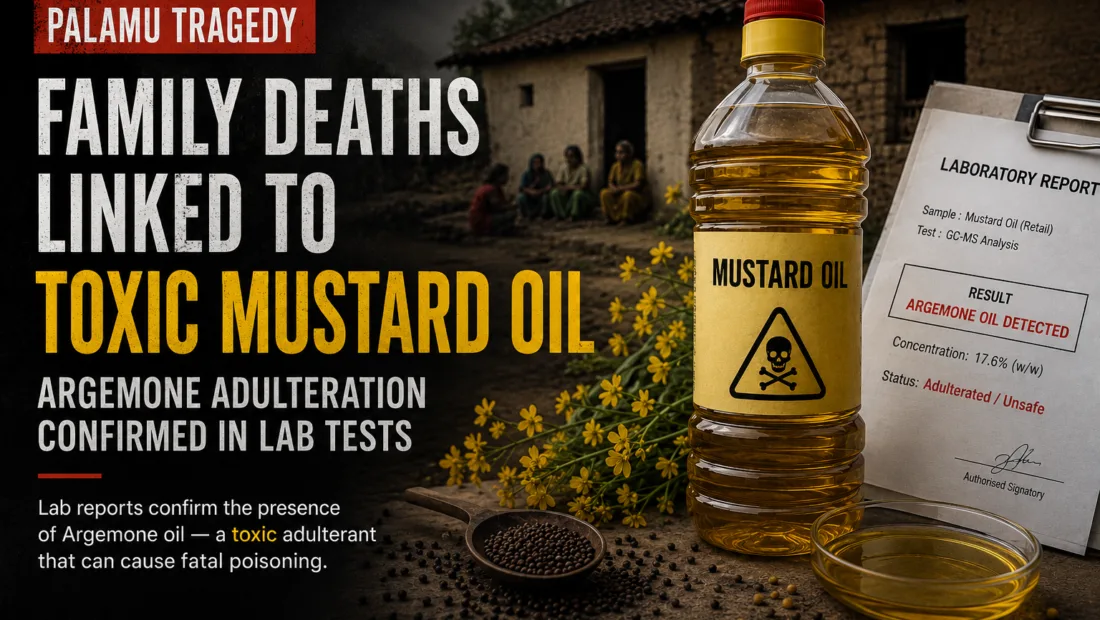
Daltonganj, July 3: The mystery surrounding the deaths of five members of a family in Palamu district’s Sikka village has been resolved after laboratory tests confirmed that the mustard oil consumed by the family was adulterated with toxic Argemone oil, health officials said.
The contamination, confirmed by both the biochemistry laboratory of Medinirai Medical College and Hospital (MMCH), Daltonganj, and the State Food Testing Laboratory in Ranchi, is believed to have caused epidemic dropsy, a potentially fatal condition resulting from Argemone poisoning.

Two Laboratories Confirm Presence of Toxic Argemone Oil
According to sources, Palamu Civil Surgeon Dr Anil Kumar Sriwastwa initiated testing of the mustard oil sample on June 30 at the MMCH biochemistry laboratory.
Four separate tests detected the presence of Argemone oil in the sample.
To verify the findings, the sample was sent to the State Food Testing Laboratory at Namkum, Ranchi, where the results matched those of the MMCH laboratory.
Food Analyst for Jharkhand, Chaturbhuj Meena, confirmed the presence of the non-edible and toxic adulterant Argemone in the mustard oil sample on July 2. The Jharkhand Story has accessed the laboratory report.

Civil Surgeon: Family Suffered From Epidemic Dropsy
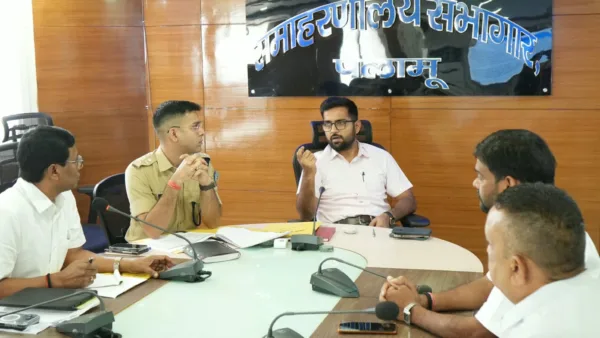
Confirming the findings, Dr Anil Kumar Sriwastwa said the mustard oil consumed by the family was contaminated.
“We have received the report from the State Food Testing Laboratory. It confirms contamination and adulteration. Argemone oil is present in the mustard oil,” he said.
“Argemone oil is unsafe for humans. It is highly toxic and can cause swelling of the limbs, severe complications and even organ damage or failure.”

The civil surgeon said the victims displayed symptoms consistent with epidemic dropsy, including swollen limbs and organ damage.
Health officials also found a considerable quantity of Argemone oil stored in containers inside the family’s house.
Survivor Recalls Loss of Five Family Members
Anuj Mehta, the lone surviving member of the family, said he was unaware of how the toxic oil got mixed with the mustard oil.
“There is a large growth of Argemone weed around our house. I don’t know how it got mixed with the mustard oil. I work as a driver and remain away from home for days,” he said.
He clarified that the family did not cultivate the weed.
“It is an invasive weed that grows on its own. Argemone oil is commonly used by cattle owners to treat cuts and bruises in livestock,” he added.
Anuj said he lost his father Kuldip Mehta (55), sisters Babita (20) and Indu (18), wife Savita (24), and brother Nakul (22).
Three deaths occurred in Palamu district, while Savita and Nakul died at Rajendra Institute of Medical Sciences (RIMS), Ranchi.
“June 20 and June 27 were the darkest days for us. We lost two family members on each of those days. Another death occurred on June 28,” Anuj said.
Delay in Viscera Dispatch Under Scanner
Sources said there was a 12-day delay in dispatching the viscera samples from MMCH Daltonganj to the Forensic Science Laboratory (FSL) in Ranchi.
Dr Anil Kumar Sriwastwa confirmed that the delay had drawn the attention of the district administration.
“It was a 12-day delay. The Deputy Commissioner has taken a serious view of the matter,” he said.
He said showcause notices were issued on July 2 to the Medical Superintendent of MMCH Daltonganj and the Head of the Department of Forensic Medicine and Toxicology, seeking an explanation for the delay in dispatching the viscera of the three victims who died in Palamu district.
Medical sources said both officials have been given 24 hours to submit their replies.