‘Valid ticket is enough’: Jharkhand HC directs Railways to pay ₹8 lakh in train fall death case
THE JHARKHAND STORY NETWORK Ranchi, July 9: In a significant ruling reinforcing the principle of strict liability under the Railways Act, the…
THE JHARKHAND STORY NETWORK
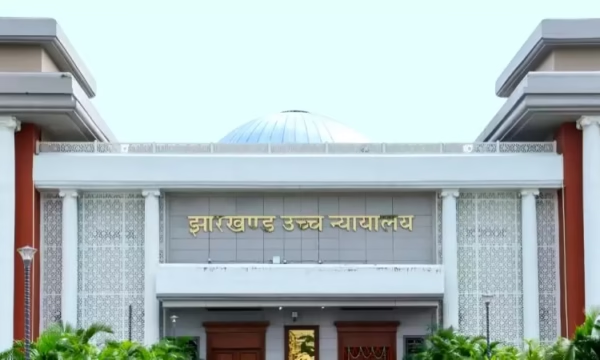
Ranchi, July 9: In a significant ruling reinforcing the principle of strict liability under the Railways Act, the Jharkhand High Court has directed the Eastern Railway to pay ₹8 lakh in compensation, along with 7% annual interest, to the family of a man who died after allegedly falling from a moving train in 2017.
Justice Sanjay Kumar Dwivedi allowed the appeal filed by the deceased’s wife and daughters, overturning the Railway Claims Tribunal’s order that had rejected their compensation claim.
High Court Finds Tribunal Erred in Rejecting Compensation Claim
The appeal challenged the Railway Claims Tribunal’s judgment dated April 26, 2023, which had dismissed the family’s claim for compensation arising from the death of Ashok Mehto alias Mahto.
According to the case records, Ashok Mehto had purchased a valid second-class railway ticket to travel from Jamui to Madhupur on August 1, 2017, and boarded the Danapur-Tatanagar Express. When he failed to return home, his family searched for him and later discovered that he had reportedly fallen from the moving train near Nawapatri Cabin. His body was recovered the following day.
A police investigation, the inquest report, and the final report in the Unnatural Death (U.D.) case concluded that Mehto had died after accidentally falling from the train. The valid travel ticket was also recovered from his possession.

Valid Ticket Established Bona Fide Passenger Status
The High Court observed that the Railway Claims Tribunal had incorrectly concluded that the deceased was not a bona fide passenger despite clear documentary evidence.
Justice Dwivedi noted that the inquest report and police investigation confirmed that the deceased was travelling on the train with a valid ticket.
Rejecting the Railway’s contention that there was no eyewitness to the ticket purchase, the Court observed:

“The plea of the Railway that there was no eyewitness to the purchase of the travel ticket is not acceptable. Every railway ticket cannot be expected to be purchased in the presence of eyewitnesses. In the present case, the travel ticket has already been proved by the railway authorities themselves.”
Body Found Away from Track Not Sufficient to Reject Claim
The Railway had argued that the body being found around 10 metres away from the railway track created doubts about whether the deceased had fallen from the train.
The High Court rejected this argument, observing that several factors could explain the body’s location after a fall from a moving train.
Relying on judicial precedents, the Court held that merely finding a body some distance away from the railway track cannot conclusively establish that the victim did not fall from a running train.
Railways Act Provides Strict Liability in Untoward Incidents
The Court reiterated that compensation under Section 124-A of the Railways Act is based on the principle of strict or no-fault liability.
Justice Dwivedi referred to Supreme Court judgments holding that compensation provisions under the Railways Act are beneficial legislation and should receive a liberal interpretation.
The Court further observed:
“Once it is proved that the deceased was travelling as a bona fide passenger and fell from the running train, the Railway cannot avoid its liability.”
The Court found no evidence that the case fell under any of the statutory exceptions, such as suicide, self-inflicted injury, criminal acts, intoxication, or natural causes.
Railway Directed to Pay Compensation Within Two Months
Allowing the appeal, the High Court set aside the Railway Claims Tribunal’s judgment and directed the Eastern Railway to pay ₹8 lakh in compensation along with interest at 7% per annum from August 1, 2017—the date of the accident—until the actual date of payment.
The Court ordered that the compensation be paid to the appellants within two months from the receipt or production of a copy of the judgment.