Worker’s legs crushed in Patratu Vidyut Nigam plant accident; officials silent on repeated safety failures
Ramgarh (Jharkhand), Oct 31: A construction worker suffered critical leg injuries after a heavy iron plate fell on him at the Patratu Vidyut…
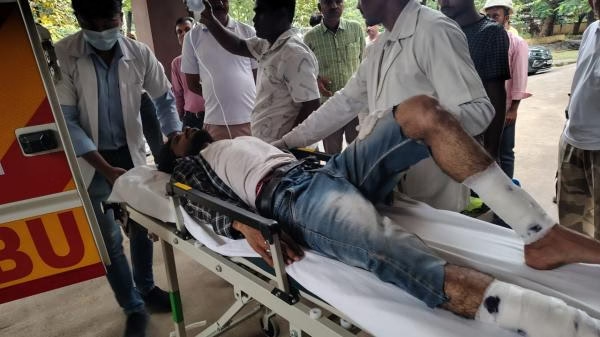
Ramgarh (Jharkhand), Oct 31: A construction worker suffered critical leg injuries after a heavy iron plate fell on him at the Patratu Vidyut Utpadan Nigam Limited (PVUNL) power plant site on Thursday. The incident has once again exposed alarming safety lapses at the under-construction project being executed under BHEL (Bharat Heavy Electricals Limited) and its contractor RVPR Company.
Crane Strap Snaps, Worker Trapped Under Iron Plate
The injured worker, Dilkhush Khan, 25, a resident of Garhwa district, was working in the boiler section of the PVUNL plant when the crane’s lifting strap broke, causing a heavy iron seat to fall on him. Both of his legs were crushed under the weight, and he briefly lost consciousness before co-workers managed to rescue him after a difficult struggle.
He was rushed to the PVUNL hospital for immediate treatment and later referred to Ranchi’s Medanta Hospital for specialized care due to the severity of his injuries.
A Series of Accidents Raises Questions About Accountability
This accident is the latest in a long list of workplace mishaps at the Patratu thermal power plant, one of Jharkhand’s largest ongoing power projects. In the last two years, several serious accidents have occurred—some fatal—yet no concrete safety reforms have been implemented.
On October 22, Satyadev Kumar, a driver working for the same company, was found dead by suicide inside the Patratu plant area.

On January 6, another RVPR worker died after being hit by a truck near the Khaira Manjhi Gate.
Multiple non-fatal injuries have also been reported due to falling materials and unsafe working conditions.
Despite repeated incidents, factory inspectors, labour department officials, and local authorities have largely remained mute spectators. Safety audits are either delayed or superficial, and no stringent penalties have been imposed on the contracting firms responsible for these sites.

Local trade unions allege that the administration turns a blind eye to violations, allowing contractors to operate without following standard industrial safety protocols.
“Workers Treated Like Animals,” Says Local Leader
Mukhiya Kishore Kumar Mahto condemned the management of PVUNL and its contractors, calling the working environment “inhuman.”
“Safety at the Patratu plant is a joke. Workers are being herded into dangerous zones without helmets or safety gear, like animals,” he said.
Mahto also alleged that basic facilities such as toilets and drinking water are missing and that some labourers are forced to pay between ₹1 lakh and ₹1.5 lakh just to secure employment at the site. He accused the company of exploiting workers while the factory inspector and district administration fail to intervene.
He urged the Deputy Commissioner, Labour Department, and local legislators to launch an independent investigation and hold negligent officials and contractors accountable.
Media Barred from Reporting the Incident
Soon after the accident, local journalists who reached the PVUNL hospital were allegedly stopped by CISF personnel and hospital management. Reporters said they were ordered to leave the premises and told that media coverage required prior permission from the District Magistrate.
Some journalists claimed that their mobile phones were taken away when they attempted to record visuals of the injured worker being shifted for treatment, raising further concerns about lack of transparency at the site.
Demands for Inquiry and Safety Reforms
Following the latest accident, labour unions and civil society organizations have renewed their demand for a comprehensive safety audit of the PVUNL plant. They have urged the state government, factory inspectorate, and BHEL management to implement stricter safety standards, ensure accountability, and protect workers’ rights.
Experts point out that the repeated silence of factory inspectors and local authorities not only reflects negligence but also suggests systemic failure in enforcing occupational safety laws at high-risk industrial sites.
The Patratu plant, a flagship power project intended to boost Jharkhand’s electricity generation, has now become a symbol of unsafe working conditions, weak oversight, and poor transparency.