Rohingya refugees in Jammu struggle for a place to bury their loved ones
Jammu, Jammu and Kashmir: Asif Hussain, a member of the Rohingya refugee community living in the Sujwan settlement on the outskirts of…
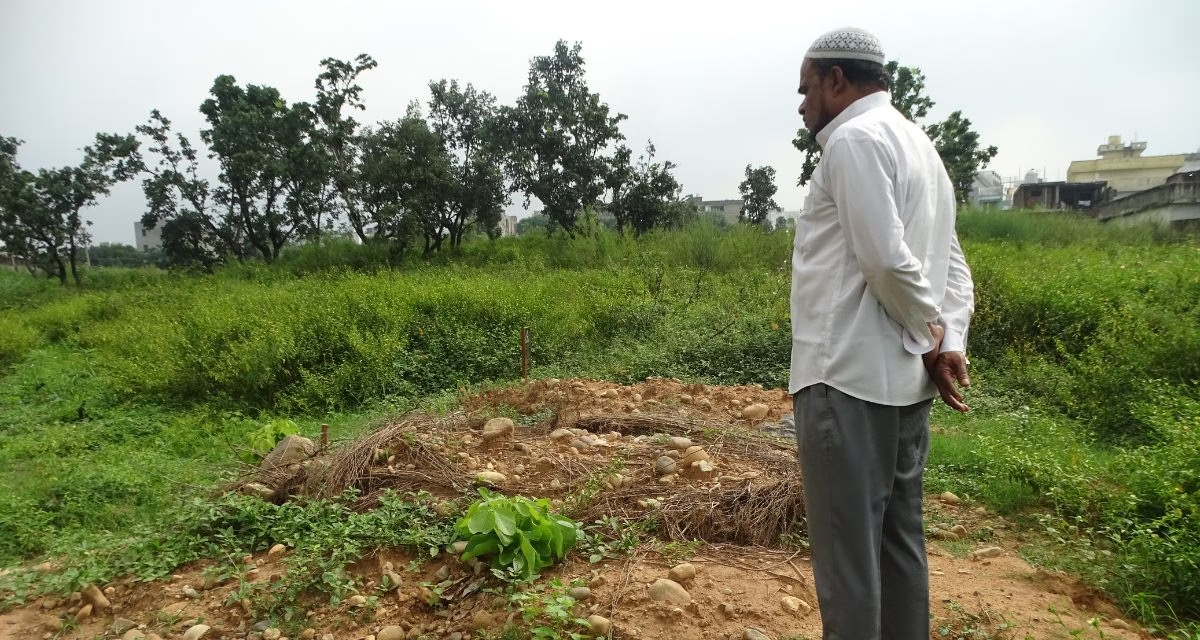
Amir Hussain, a community leader of Rohingya refugees, praying Fatihah at the graveyard in Channi Rama (Photo - Urvat il wuska, 101Reporters)
Jammu, Jammu and Kashmir: Asif Hussain, a member of the Rohingya refugee community living in the Sujwan settlement on the outskirts of Jammu, still remembers the long walk through the forest with his brother’s body.
In 2018, when Salam Hussain died of kidney disease, there was no place in Jammu where he could be buried. Asif (45), a daily-wage labourer had to take him nearly 50 kilometres away, to a forest area in Kathua.
“I had to arrange Rs 5,000 for travel and burial expenses,” Asif recalled. “We hired a load carrier, and after reaching the base of the forest, we trekked for an hour to reach the spot. That experience still haunts me. We don’t even have the courage to visit his grave now, fearing wild animals may have disturbed the body.”
For Muslim families, the Janazah prayer before burial is a communal obligation, meant to be attended by as many people as possible. But for families like Asif’s, distance and fear make that impossible. “Because the burial sites are so far away, many people can’t join. What should have been a communal prayer becomes a lonely act,” he said. “In such times, you need your people around you, but we are left to mourn alone.”
Across Jammu, over 13,000 Rohingya refugees face this same struggle, denied even the dignity of a grave. Living in temporary settlements in Channi Rama, Kiryani Talab, Narwal, Bhatandi and Sujwan, they have no access to designated burial grounds. Families often travel 40-50 kilometres to forested areas in Qasim Nagar, Sidhra or Kathua to bury their dead.

The Rohingya, a predominantly Muslim ethnic minority from Myanmar’s Rakhine state, fled large-scale persecution and violence beginning in the 1990s, with the largest exodus after 2017. Around 40,000 are estimated to live across India, mostly in Jammu, Delhi, Hyderabad and Haryana. Though registered with the United Nations High Commissioner for Refugees (UNHCR), they are not formally recognised as refugees under Indian law, leaving them in a state of legal limbo, without citizenship rights or assured access to housing, education, or burial grounds.
The absence of safe and dignified burial spaces raises a painful question: when displaced people are denied the right to rest their dead, what protection do they have left in life?
Also Read- Centre adds wildlife and waterlogging-related crop loss to PM Fasal Bima Scheme coverage
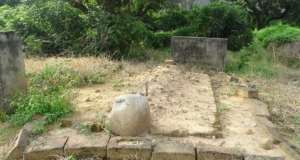
Scattered grave
Rohingya families also carry the emotional burden of invisibility in death, said Rahimulla, 35. “We don’t place names or details like other Muslims, which usually gives a sense of identity. That’s why it feels like we vanish with death,” he said.

Even in hardship, families honour their dead in the few ways they can. “We place simple stones over the graves so we know they exist. Only close family knows who is buried where,” he added.
Amir Ali (75) who came to India with his family in 2008, said they have long struggled to find a place to live and a place to rest. “Whenever someone dies, we rely on local residents to help us bury them. Some allow us to use their graveyards, like the one in Bhatindi, but even that is uncertain. Recently, locals asked us to find a separate graveyard, saying they had limited space. It’s becoming harder to ensure a proper resting place for our loved ones,” he said.
Without a dedicated burial ground, graves are scattered across forests and small local graveyards, leaving families divided even in death.
Rahman Ali (55) had to bury his parents in separate graveyards. “It divides families even in death and makes it difficult to grieve or preserve a sense of belonging,” he said. “There’s no place to mourn together or honour our dead. It feels like they’re disappearing, and all we’re left with is sorrow.”
“I want to visit my parents’ graves,” said Rahimulla quietly. “But they’re too far. A graveyard close to our settlement would mean we could at least hold on to their memory, instead of feeling scattered even in death.”
He said graves serve as anchors of community and cultural identity. “When families can’t bury their dead together, it fragments not just grief but the cohesion of the entire community.”
Rahimulla, who teaches children in his settlement near Kiryani Talab, said the loss extends beyond individual families. Rahmatullah, 25, added why a separate graveyard matters: “It would preserve our identity. Even if one day we return to our country, we could visit our ancestors and remember the struggles our families endured.”
Also Read- ED cracks down on coal mafia; over 40 locations raided in Jharkhand, Bengal
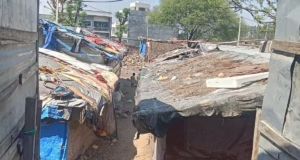
Between law and humanity
“Rohingya Muslims in India live under legal uncertainty and are often treated as ‘illegal immigrants’ despite being recognised by the United Nations High Commissioner for Refugees (UNHCR),” said human rights activist Nayla Hashmi. “This lack of clarity affects every aspect of their lives, including access to a dignified burial. Ensuring such basic rights is essential to easing their hardship.”
“International human rights standards emphasise that dignity and life extend beyond death,” she added. “While India has not ratified all refugee-specific treaties, it still has an obligation to protect displaced communities on humanitarian grounds.”
Even though Rohingyas are not officially recognised as refugees and can technically be deported under the Foreigners Act, they are still protected by Article 21 of the Constitution, which guarantees the right to life and personal liberty. “This right applies to every person on Indian soil,” Hashmi said. “That includes the right to basic human dignity, such as a proper and respectful burial.”
The Foreigners Act regulates the status of non-citizens but does not provide rights such as housing, employment or burial grounds. However, the Supreme Court has clarified that while foreigners may not have the right to remain in India, they cannot be denied basic human rights during their stay. Thus, access to burial grounds for Rohingyas is protected not by the Foreigners Act but by the constitutional guarantee of Article 21.
In practice, most Rohingyas in India are registered with the UNHCR, which helps document their presence and ensures limited recognition of their humanitarian needs. Across the country, about 16,500 Rohingyas are registered with the agency, including around 5,700 in Jammu (2024-25 estimates).
Hashmi said the limited access to burial grounds highlights the need for policies that combine legal clarity with humanitarian care. “Refugees should not have to face additional suffering even after death,” she said.
“We are grateful to India for giving us a place to live,” said Amir Hussain, a community leader in the Narwal settlement. “But when it comes to burying our dead, forests and occasional help from locals are not enough.”
Also Read- Foggy morning, clear sky to prevail over Jharkhand
“Providing a separate graveyard is not just about burial,” he added. “It is about mental peace, cultural preservation and giving our children a connection to their heritage. Without it, the grief of the living remains unresolved and the memory of the dead fades away.”
He appealed to the administration “on humanitarian grounds” for a dedicated graveyard with state support. “It would allow our community to honour our loved ones safely and with dignity, and preserve our identity and traditions even in these difficult times.”
Repeated attempts to contact officials from the district administration and forest department went unanswered.
(Urvat il wuska is a freelance journalist and a member of 101Reporters, a pan-India network of grassroots reporters.)