West Bengal Polls: Why Eastern India needs a resurgent Bengal for Jharkhand to thrive
As West Bengal heads into another Assembly election, much of the political debate remains centred on local concerns—governance, welfare, and political…

Narendra Modi (L) and Mamata Banerjee (R)
As West Bengal heads into another Assembly election, much of the political debate remains centred on local concerns—governance, welfare, and political contestation. Yet, the implications extend beyond its borders. For Jharkhand, the question is structural and long-term: can it achieve meaningful development without an industrially vibrant West Bengal? The answer, rooted in history and economics, is no.
An Off-the-Record Insight
Some time ago, during a visit to Jharkhand, a senior official from the Japanese embassy made a candid remark in a private, off-the-record conversation. He said that an entrepreneur sitting in Tokyo does not think of Jharkhand while planning overseas investments. The first choices are cities like Mumbai, Delhi, Bangalore, Hyderabad and increasingly Ahmedabad. There was a time when Kolkata also featured prominently in that list.
That, he said, has changed.
Today, investors rarely consider Kolkata, and Jharkhand enters the picture only if someone happens to visit the city and then learns about its geographical advantages. If Bengal—once seen as the Gateway to the East—no longer attracts investors, the chances of investment flowing into Jharkhand become extremely limited.
This remark, though informal, captures a larger economic truth.

Historical Roots: From Bengal Presidency to Jharkhand
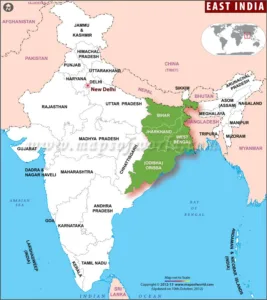
The relationship between Jharkhand and West Bengal is deeply historical. Before Jharkhand was carved out of Bihar in 2000, and even before it became part of Bihar in 1912, the region was administered under the Bengal Presidency during British rule.
Areas such as Chotanagpur, Santhal Parganas, Singhbhum, and Palamu were governed from Calcutta, which served as the administrative and commercial capital. This created early economic and institutional linkages between the mineral-rich plateau and the urban-industrial centre.

Even after administrative separation, these linkages continued, with Jharkhand remaining economically tied to Kolkata and the wider Bengal region.
Kolkata: The Gateway to the East
For decades, Kolkata was known as the Gateway to the East—the principal port, financial hub, and decision-making centre for eastern India. Trade, capital, and industrial planning flowed through it.
For a landlocked and resource-rich region like Jharkhand (the part of erstwhile Bihar), this gateway was critical. Minerals extracted from its mines moved through rail networks to Kolkata’s port, connecting them to national and global markets. Investment decisions were often taken in boardrooms located in the city.
Industrial Logic: Why Proximity Mattered
The interdependence between the two regions is best illustrated by the establishment of Tata Steel in Jamshedpur in 1907. While the presence of iron ore, coal, and water made the location viable, proximity to Kolkata made it strategic.
Kolkata provided access to port facilities for importing machinery and exporting finished steel, along with financial networks, administrative support, and skilled manpower. Rail connectivity ensured the smooth movement of goods.
Jamshedpur was not an isolated industrial town—it was part of a larger economic ecosystem anchored in Kolkata.
The same logic applied in later decades. Institutions such as the Damodar Valley Corporation and Coal India Limited chose Kolkata as their headquarters, even though their operations were largely in present-day Jharkhand.
Enterprise Flows: From Kolkata to Jharkhand
This relationship was not limited to large institutions. Individual entrepreneurs also carried capital, skills, and business networks from Kolkata into the Jharkhand region.
A notable example is Basant Kumar Jhawar, a young industrialist who moved from Kolkata to Ranchi with modest resources and went on to establish Usha Martin in the 1960s. What began as a small initiative grew into one of India’s leading wire rope manufacturers, with Ranchi emerging as a major industrial base.
Many other business families and trading communities, particularly Marwari entrepreneurs based in Kolkata, followed a similar path, setting up operations in mining, metals, transport, and ancillary industries across Ranchi, Dhanbad, and Jamshedpur. These ventures were often financed or managed from Kolkata, reinforcing its role as the region’s economic nerve centre.
This flow of enterprise highlights that Jharkhand’s industrialisation has historically depended on networks rooted in Bengal.
Cultural Continuities: Ghatshila and Beyond
The connection between Jharkhand and Bengal is not only economic but also cultural. For generations, Bengalis have looked to parts of present-day Jharkhand as extensions of their social and cultural space.
Ghatshila holds a special place in the Bengali imagination. Nestled along the Subarnarekha River, it became a favoured retreat for families, writers, and artists. The celebrated author Bibhutibhushan Bandyopadhyay spent time there, adding to its cultural significance.
Ranchi, too, carries a strong imprint of this shared heritage. Tagore Hill is associated with Jyotirindranath Tagore, the elder brother of Rabindranath Tagore, linking the region to Bengal’s cultural renaissance.
This cultural geography extends further. Ishwar Chandra Vidyasagar spent significant time in Karmatar in present-day Jamtara district, working for education and social reform. Raja Rammohan Roy had links with the region of Chatra.
Topchanchi in Dhanbad is remembered for its association with the legendary actor Uttam Kumar. Deoghar, apart from being a major religious centre, also has an important historical link with Sri Aurobindo, who spent time there after being named in the Alipore bomb case before moving to Puducherry.
Bibhutibhushan Bandyopadhyay’s experiences in the forests of Palamu are often seen as influencing works such as Pather Panchali, further binding Jharkhand’s landscape with Bengal’s literary imagination.
Similarly, towns like Madhupur, Deoghar, and Ranchi became “second homes” for Bengalis. The word “changer,” still used locally, reflects this long-standing relationship.
Even today, a significant proportion of tourists visiting Jharkhand come from West Bengal. Recent outreach by the Jharkhand government in Kolkata highlights this continuing connection, with the state’s tourism minister describing the two regions as “two pages of a shared heritage.”
Decline of West Bengal’s Industrial Base
Despite its historical advantages, West Bengal began to lose its industrial prominence from the 1960s onwards. Political instability, labour unrest, and frequent strikes created uncertainty for businesses.
The Freight Equalisation Policy reduced the advantage of proximity to raw materials, allowing industries to move elsewhere. Over time, major business houses shifted to cities like Mumbai and Delhi.
Infrastructure challenges and slower adaptation to economic liberalisation in the 1990s added to the problem. Setbacks such as the Singur episode reinforced the perception of risk.
Gradually, Kolkata lost its position as a leading commercial hub, and with it, the wider region lost momentum.
Ripple Effect on Jharkhand
For Jharkhand, this decline has been consequential. The state possesses abundant natural resources, but resources alone are not enough to attract investment.
Investors look for ecosystems—connectivity, ports, skilled labour, and financial networks. Historically, much of this ecosystem was anchored in West Bengal.
As that anchor weakened, Jharkhand found it harder to attract large-scale investment, with reduced visibility and confidence.
Bengal’s Industrial Decline Benefited Odisha—and Bypassed Jharkhand
West Bengal’s industrial decline has, over time, worked to the advantage of neighbouring Odisha. As investors moved away from Bengal due to policy uncertainty and stalled projects, many turned to alternative destinations within eastern India.
Odisha, with proactive policies, smoother land acquisition, and a focus on mining and metals, emerged as a preferred choice. Industrial belts in Angul, Jharsuguda, and Kalinganagar began attracting investments that might once have flowed through Kolkata. The presence of Paradip Port further strengthened Odisha’s position by providing efficient access to global markets.
For Jharkhand, this shift has been a double setback. It lost the advantage of a strong regional anchor and saw investments bypass it despite similar resource strengths.
Why Jharkhand Cannot Develop in Isolation
The idea that Jharkhand can chart its development path independently does not align with these realities. Its economy has always been linked to a broader regional framework.
A resurgent West Bengal can help rebuild that framework through stronger infrastructure, improved connectivity, and renewed investor interest. Trade can deepen, and employment opportunities can expand.
Larger Regional Question
The stakes of West Bengal’s Assembly election go beyond the state itself. The outcome will influence whether eastern India can re-emerge as a dynamic economic region or continue to lag.
A revival of Kolkata as the Gateway to the East can restore regional balance. Without it, states like Jharkhand may continue to struggle despite their strengths.
A Shared Destiny
Jharkhand’s journey—from the Bengal Presidency to Bihar and finally statehood in 2000—has not erased its economic ties with West Bengal.
The lesson from history is clear. When Kolkata thrived, Jharkhand also prospered. When it declined, the effects were felt across the region.
As West Bengal votes, the implications extend beyond its borders. For Jharkhand, a resurgent and industrially vibrant West Bengal is not just desirable—it is essential for its future.