Jharkhand HC declines to interfere in Bokaro land dispute, says Article 226 cannot decide disputed facts
The Jharkhand Story Network Ranchi, July 9: The Jharkhand High Court has dismissed a writ petition challenging an order of the Sub-Divisional…
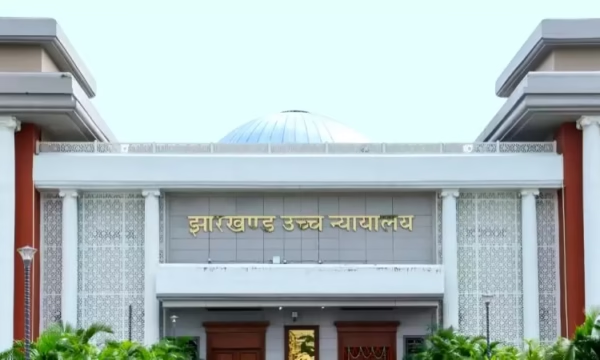
The Jharkhand Story Network
Ranchi, July 9: The Jharkhand High Court has dismissed a writ petition challenging an order of the Sub-Divisional Officer (SDO), Chas, in a land dispute in Bokaro, holding that disputed questions relating to title, possession and encroachment cannot be adjudicated under Article 226 of the Constitution.

Justice Sanjay Kumar Dwivedi upheld the SDO’s order, observing that it had been passed to maintain law and order and that there was no material to establish arbitrariness or abuse of power warranting interference by the High Court.
The petitioner, Md. Shahid Raja, challenged an order dated April 10, 2012, by which the SDO directed deployment of police to restore possession of a parcel of land in favour of another claimant.
The petitioner contended that his father had purchased eight decimals of land in 1979, that the land had been mutated in his father’s name and that he had been unlawfully dispossessed pursuant to the SDO’s order.
The State submitted that the order had been passed solely to prevent a breach of law and order following complaints regarding possession of the property. During the pendency of the case, the disputed land was sold to another purchaser, whose name was subsequently mutated in the revenue records.

No adjudication of title under Article 226
The Court noted that the petitioner had referred to registered sale deeds in the writ petition but had failed to produce them despite stating that they would be placed on record.
It also observed that the petition involved disputed questions relating to land boundaries, possession and encroachment, which could not be resolved in writ proceedings.
The judgment said such disputes require adjudication through appropriate civil proceedings and not under the High Court’s extraordinary jurisdiction under Article 226.

Law and order within executive domain
Referring to Supreme Court precedents, the Court reiterated that decisions taken by administrative authorities to maintain public order are ordinarily not open to judicial interference unless there is clear evidence of arbitrariness, mala fides or patent illegality.
Finding no such infirmity in the SDO’s action, the Court dismissed the writ petition, holding that maintenance of law and order falls within the executive’s domain and that the impugned order did not warrant interference under Article 226 of the Constitution.