






SUMAN K SHRIVASTAVA
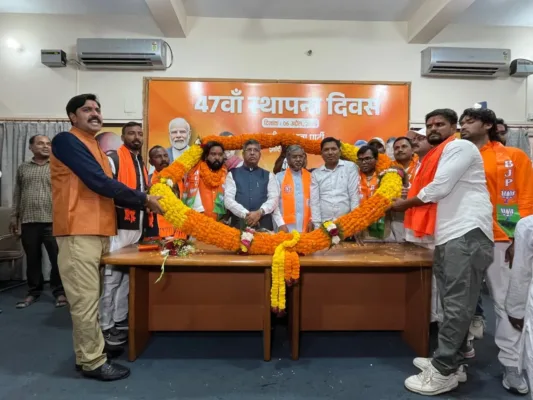
 As the Bharatiya Janata Party (BJP) marks its Sthapna Diwas, celebrating its growth across India, Jharkhand presents a contrasting picture — a state where the party once dominated but has steadily seen its base erode.
The region, earlier part of south Bihar, was nurtured politically by the Rashtriya Swayamsevak Sangh (RSS) and its affiliates. When Jharkhand was carved out in 2000, the BJP emerged as a key force, winning 32 seats in the first Assembly election and forming the government.

Shrinking Numbers, Rising Rivals
Since then, the BJP’s electoral performance in Jharkhand has shown a fluctuating but overall declining trend. The party won 30 seats in 2005, 18 in 2009, rose to 37 in 2014 to form a majority government, but slipped again to 25 in 2019, losing power to the Jharkhand Mukti Morcha (JMM)-led alliance. It went down further to 21 in 2024.
This decline reflects a deeper political shift. The BJP has gradually lost its hold over tribal voters, creating space for the JMM to consolidate its position. Today, the JMM is firmly entrenched, capable of leading the government with support from smaller allies.
RSS and the Tribal Identity Challenge
A key but often understated factor is the challenge faced by the RSS in balancing its broader Hindu assimilation agenda with the distinct identity of Jharkhand’s tribal communities.
In the state, tribal politics is deeply rooted in cultural and religious identity. Movements demanding a separate Sarna religious code and resistance to the perceived “Hinduization” of indigenous beliefs have gained traction. This has often put the RSS and its affiliates at odds with local sentiments.
Accusations of attempts to dilute tribal culture, coupled with opposition from local leadership, have complicated efforts to rebuild trust among Adivasi voters — once a crucial BJP support base.
Leadership Vacuum and Strategic Drift
The BJP’s troubles in Jharkhand are also tied to a lack of strong, credible state leadership. There is no leader currently who can match the political acumen and mass appeal of Chief Minister Hemant Soren.
After the debacle in the 2019 Assembly elections, the party brought Babulal Marandi back into its fold after a gap of 14 years, hoping to revive its prospects. However, party cadres took time to align with him, and internal resistance persisted. His rivals repeatedly invoked his past anti-BJP remarks — including the oft-quoted “Qutub Minar se kood jayenge” rhetoric — to corner him politically.
For reasons not clearly explained, Marandi held both the posts of state president and Leader of Opposition for a considerable period. He was later replaced by Aditya Sahu, a Rajya Sabha member with limited grassroots presence.
Marandi’s sustained attacks on Hemant Soren over alleged corruption failed to yield political dividends. Instead, counter-allegations surfaced, and JMM leader Supriyo Bhattacharya’s remark — that Marandi “speaks of corruption only when he doesn’t get his cut money” — gained traction.
The party’s earlier experiment with Raghubar Das also proved costly, as his tenure alienated key sections. At present, Raghubar Das finds himself with a limited role in Jharkhand BJP after stepping down as Odisha Governor, despite expectations of a renewed political innings.
According to political watchers, Arjun Munda could have emerged as a stabilising force, but his influence declined significantly after his defeat in the Khunti Lok Sabha seat, further weakening the BJP’s tribal leadership base.
ED Action and Political Turnaround
The Enforcement Directorate’s move to arrest Hemant Soren, a sitting chief minister, in a ‘weak’ land-related case — which the JMM alleged was under political pressure from BJP leaders — also appears to have backfired politically.
Soren’s subsequent bail from the Jharkhand High Court shifted the political narrative, allowing the JMM to project the episode as an instance of political targeting. The development not only revived sympathy but also energised the party’s support base.
It also marked the emergence of Kalpana Soren as a significant political figure. Her growing public appeal and effective oratory quickly captured attention, helping expand the JMM’s outreach. At present, the BJP lacks a comparable woman leader in Jharkhand who can match Kalpana Soren’s connect and communication style.
Issues That Failed to Resonate
Beyond corruption, the BJP raised issues such as alleged Bangladeshi infiltration. Still, these failed to gain wider political traction in Jharkhand, where local identity and land-related concerns dominate voter priorities.
The party also relied on allies like AJSU and Sudesh Mahto to consolidate Kurmi votes. Still, this strategy has not delivered consistent results, with emerging leaders like Jairam Mahto beginning to occupy that space.
Notably, the BJP leadership has also shown little political engagement with the lone JD(U) MLA Saryu Roy, missing an opportunity to strengthen the NDA’s prospects in the state.
Time for Course Correction
Jharkhand’s political landscape underscores the importance of grassroots engagement and strong regional leadership. The BJP in the state was built by leaders such as Govindacharya, Karia Munda, and Lalit Oraon, and others who focused on organisational depth.
Today, the situation calls for introspection rather than celebration. The party needs to move beyond drawing-room strategies and reconnect with the grassroots to understand the reasons behind its decline.
Sthapna Diwas, in this context, is not just a moment of commemoration for the BJP in Jharkhand, but a reminder that rebuilding its base will require honest assessment, course correction, and renewed political engagement.