
Jharkhand case spurs SC guidelines: HCs must deliver reserved judgments in 3 months
New Delhi, May 29: In a landmark judgment with nationwide implications, the Supreme Court on Friday issued binding guidelines to all High…
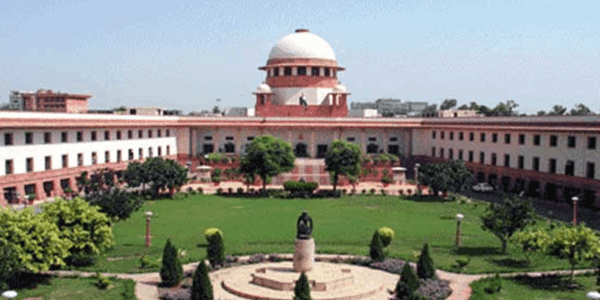
New Delhi, May 29: In a landmark judgment with nationwide implications, the Supreme Court on Friday issued binding guidelines to all High Courts for the timely delivery of reserved judgments, a move triggered by a case arising from the Jharkhand High Court where criminal appeals remained pending for years after arguments had concluded.
A Bench comprising Chief Justice of India Surya Kant and Justice Joymalya Bagchi directed that High Courts should endeavour to pronounce reasoned judgments within three months of reserving them. The Court also laid down strict timelines for bail matters, directing that bail orders should preferably be pronounced and uploaded on the same day and, if reserved, no later than the following day.

Jharkhand Case Behind Landmark Directions
The directions stem from a petition filed by four convicts belonging to the Scheduled Tribes and Other Backwards Classes who alleged that their criminal appeals before the Jharkhand High Court had remained pending for two to three years after judgments were reserved.
The petitioners argued that such prolonged delays violated their fundamental rights under Article 21 of the Constitution, including the right to life, personal liberty and speedy justice.
Recognising the larger significance of the issue, the Supreme Court expanded the scope of the proceedings and sought details from High Courts across the country regarding pending reserved judgments before framing the new guidelines.
Bail Matters Get Top Priority
Emphasising that cases involving personal liberty require urgent attention, the Supreme Court directed High Courts to display “extra promptitude” in matters relating to regular bail, anticipatory bail and sentence suspension.

The Court said bail orders should preferably be pronounced and uploaded on the same day. If reserved, they must be delivered and uploaded within 24 hours.
It further directed that orders granting bail or suspending sentences should be communicated immediately to jail authorities to facilitate the release of undertrials or convicts on the same day or, at the latest, the next day, subject to compliance with bail conditions.
Mechanism to Prevent Delays
To ensure accountability, the Supreme Court directed High Courts to create administrative systems to monitor reserved judgments.

If a judgment remains pending for more than three months, the Registrar General must place the matter before the Chief Justice of the High Court. If delays continue, litigants will be entitled to seek reassignment of the case to another Bench for a fresh hearing and early disposal.
The Court also ruled that where only the operative portion of a judgment is pronounced, the detailed reasoned judgment should ordinarily be uploaded within seven days and, in any case, within 15 days.
Greater Transparency Ordered
High Courts have also been directed to update their websites to display the date on which a judgment was reserved. Litigants and lawyers must be informed electronically when judgments are uploaded.
Certified copies of judgments will now be required to state the dates of reserving, pronouncement, and uploading of the judgment, ensuring greater transparency in judicial proceedings.
Major Judicial Reform
Legal observers view the directions as one of the most significant judicial reforms in recent years, addressing a long-standing concern over delays in pronouncing reserved judgments.
The Supreme Court noted that delayed verdicts can cause serious hardship to litigants, particularly in criminal cases involving incarcerated persons, and stressed that the timely delivery of judgments is an integral component of access to justice.