
Jharkhand HC pulls up DCs for delaying bank recovery cases, issues statewide directions
SUMAN K SHRIVASTAVA Ranchi, July 15: In a significant ruling aimed at expediting recovery of public money locked in defaulted loans, the…
SUMAN K SHRIVASTAVA
Ranchi, July 15: In a significant ruling aimed at expediting recovery of public money locked in defaulted loans, the Jharkhand High Court has directed all District Magistrates (DMs) and Chief Judicial Magistrates (CJMs) across the State to dispose of long-pending applications filed under Section 14 of the Securitisation and Reconstruction of Financial Assets and Enforcement of Security Interest (SARFAESI) Act, 2002, within strict timelines, while holding that their role is purely ministerial and not adjudicatory.
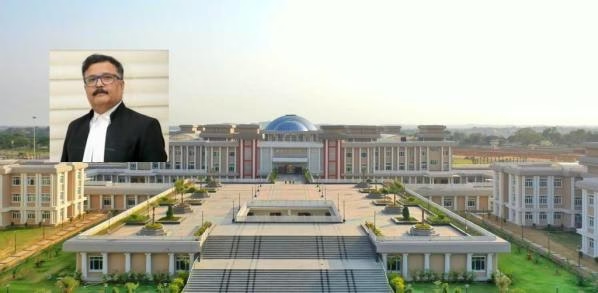
Justice Ananda Sen issued the directions while deciding a batch of writ petitions filed by several banks and financial institutions, including Jharkhand Gramin Bank, Canara Bank, UCO Bank, Jana Small Finance Bank, HDFC Bank and others, which complained that applications seeking administrative assistance for taking physical possession of mortgaged properties had remained pending far beyond the statutory period, frustrating the object of the SARFAESI Act.
The Court observed that the SARFAESI Act was enacted to ensure speedy recovery of non-performing assets by empowering secured creditors to enforce security interests without intervention of courts or tribunals. Delays in processing applications under Section 14, the Court held, undermine the very purpose of the legislation by preventing banks from taking possession of secured assets and recovering public money.
Justice Sen emphasised that banks hold public funds in trust and that recovery mechanisms created by Parliament cannot be rendered ineffective by administrative inaction. The Court noted that prolonged pendency of Section 14 applications confers an unintended advantage upon defaulting borrowers and defeats the legislative intent behind the special statute.
District Magistrates Cannot Conduct Title Enquiries
Rejecting the State’s contention that District Magistrates require additional time to examine title, legality of transfers, or issues arising under tenancy laws such as the Chota Nagpur Tenancy Act, the Court held that such enquiries fall outside the scope of Section 14.

The judgment categorically held that District Magistrates exercise only a ministerial function under Section 14 and cannot undertake adjudication regarding ownership disputes, validity of transfers or rights of borrowers. Once the secured creditor satisfies the statutory requirements by filing the prescribed affidavit, the authority is obligated to facilitate possession of the secured assets.
The Court relied upon Supreme Court decisions, including Balkrishna Rama Tarle v. Phoenix ARC Pvt. Ltd., C. Bright v. District Collector, Standard Chartered Bank v. V. Noble Kumar, and Authorised Officer, Indian Bank v. D. Visalakshi, reiterating that the powers exercised under Section 14 are administrative in nature and that “time is of the essence” under the SARFAESI framework.
Borrowers Have No Role at Section 14 Stage
Justice Sen also clarified that borrowers have no right to participate in proceedings under Section 14 of the SARFAESI Act. Any challenge to the actions of secured creditors lies before the Debts Recovery Tribunal under Section 17 of the Act, and not before the District Magistrate while considering an application for assistance in taking possession.

The Court observed that principles of natural justice requiring notice to borrowers do not apply at this stage, as the statutory scheme specifically limits the authority’s role to facilitating possession after verifying compliance with procedural requirements.
Alarming Pendency Across Jharkhand
Expressing concern over mounting delays, the High Court recorded that reports submitted by District Magistrates revealed a large backlog of pending SARFAESI applications. Ranchi alone had 146 pending matters, Dhanbad 308, East Singhbhum 203, Bokaro 65 and Hazaribagh 64. The Court described the pendency in these districts as “really alarming.”
The Court also noted that 59 applications were pending before the Chief Judicial Magistrate, Jamshedpur, and 24 before the Chief Judicial Magistrate, Dhanbad, with all cases pending beyond the statutory period contemplated under Section 14.
Time-Bound Directions Issued
Accepting undertakings furnished by senior district officials during the proceedings, the High Court directed the Deputy Commissioners of Ranchi, Hazaribagh, Bokaro, Dhanbad and East Singhbhum to clear all pending Section 14 applications within six weeks, four weeks, four weeks, eight weeks and eight weeks respectively.
District Magistrates in all remaining districts have been directed to dispose of pending applications within three weeks.
The Court further ordered the Chief Judicial Magistrate, Jamshedpur, to clear all pending applications within 60 days, while the Chief Judicial Magistrate, Dhanbad, has been directed to complete the exercise within 30 days. Other CJMs with single-digit pendency have been directed to dispose of applications within 15 days. Principal District Judges of Jamshedpur and Dhanbad have been asked to monitor compliance and submit reports within 90 days.
Administrative Registers for Transparency
In a major administrative reform, the High Court directed every District Magistrate and Chief Judicial Magistrate in Jharkhand to maintain a dedicated register recording the filing, consideration, disposal and execution dates of every application under Section 14 of the SARFAESI Act.
The Court instructed that the registers be reviewed periodically by the concerned authorities to monitor pendency and ensure timely disposal. Relevant extracts of these registers may also be made available under the Right to Information Act, the Court said, to enhance transparency and accountability.
Significant Boost for Banks
The judgment is expected to provide substantial relief to banks and financial institutions struggling to recover secured assets due to prolonged administrative delays. By reaffirming that proceedings under Section 14 are ministerial and prescribing institutional mechanisms for monitoring pendency, the High Court has sought to strengthen the effectiveness of the SARFAESI Act and accelerate recovery of public funds tied up in non-performing assets.
The batch of writ petitions was accordingly disposed of with comprehensive directions to authorities across the State to ensure strict compliance with the statutory framework under the SARFAESI Act.