Orchard farming boosts livelihood of over 400 families in Seraikela-Kharsawan
PINAKI MAJUMDAR Jamshedpur, July 23: More than 400 rural families in Jharkhand’s Seraikela-Kharsawan district are charting a new path to prosperity…
PINAKI MAJUMDAR
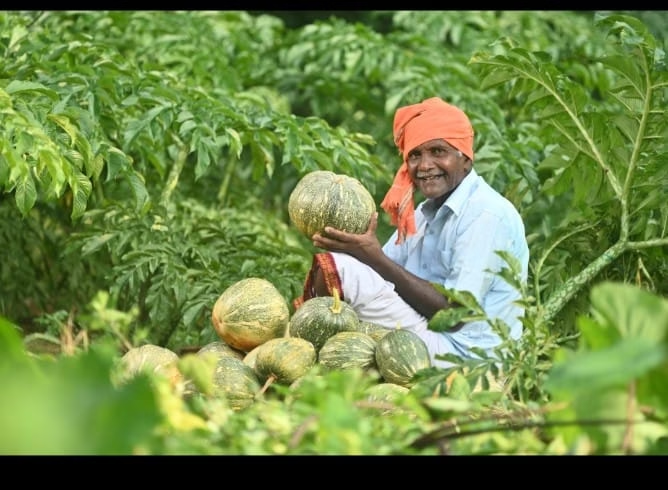
Jamshedpur, July 23: More than 400 rural families in Jharkhand’s Seraikela-Kharsawan district are charting a new path to prosperity through orchard-based farming, a transformative livelihood model introduced under the WADI initiative.
Launched in 2016-17, the initiative is a joint effort by the Tata Steel Foundation and the National Bank for Agriculture and Rural Development (NABARD).
The WADI model encourages small-scale orchard development alongside soil and water conservation, intercropping, renewable energy use, and market integration. In this region alone, 379 acres of land have been converted into orchards.
Most families cultivate 1–2 acres, primarily growing mango and guava in a 70:30 ratio. As a result, annual household incomes have increased substantially, with some families earning up to ₹1.5 lakh per year.

Also Read- Justice Tarlok Singh Chauhan sworn in as Chief Justice of Jharkhand High Court
“Initially, agriculture wasn’t seen as viable here due to the area’s mining background,” says Anant Singh, Head of Agriculture at Tata Steel Foundation.
“But now, communities are leading the way—planning orchards, managing intercropping, and earning a respectable income,” he added.
Strengthening the Farming Ecosystem
The initiative also focuses on post-harvest management through cold storage and aggregation units.

Farmers sell produce in local markets such as Sini, Saraikela, Kharsawan, Kandra, and Gamharia, and during peak seasons, they supply to larger platforms including Jamshedpur Mandi and NABARD’s Mango Festival in Ranchi.
At the grassroots level, 19 Udyan Vikas Samitis (UVS) have been formed to manage orchard upkeep and foster collective decision-making.
These community groups also oversee a Rs 1.5 lakh local fund used for operational needs—underscoring the participatory spirit of the project.
Over 1,600 farmers have been trained in orchard management, intercropping, and pest control through partnerships with institutions like ICAR-RC, Plandu and Ramakrishna Mission, Ranchi.
Also Read- Fake embassy busted in Ghaziabad, one arrested
Women at the Forefront
One of the most striking impacts has been the rise in women’s participation. Over 90% of women involved report increased financial independence, supported by Self Help Groups (SHGs) and the Jharkhand State Livelihood Promotion Society. They now access low-interest loans for nursery development, composting, and other micro-enterprises.
Stories of Change
The project is rewriting life stories. Sukurmani Soren, once a daily wage worker in the city, returned home and planted 110 fruit trees. With intercropping and sales of fruits and vegetables, her annual income rose from Rs 10,000 to Rs 48,000.
“I just wanted a better future for my children. Now they have it because I stayed back and worked my own land, ” she said.
Her efforts also contributed to groundwater recharge and brought safe drinking water to her village.
Malti Soren, a mother of four daughters, transitioned from firewood collection to goat rearing with community support. She now owns more than 1,600 goats, valued at over Rs 1.44 lakh.
“One goat fetches Rs 10,000, a kid Rs 8,000,” she explains, adding that this has allowed her to educate her daughters and inspire other women to pursue their dreams.
Also Read- Jharkhand News: Six feared trapped after mine caves in during illegal mining in Dhanbad
Empowering the Next Generation
Young farmers are also leading the change. Arjun Mardi, board member of Ual-Baha Farmer Producer Company (FPC), expanded his orchard to two acres, embraced intercropping, and raised his income from Rs 38,000 to Rs 1.1 lakh annually.
He now shares knowledge via his YouTube channel. “We aim to reach a Rs 10 lakh turnover this year, including Rs 3 lakh from the annual flower show,” he says.
Similarly, Lakhan Kisku boosted his income from Rs 29,000 to Rs 65,000 by adopting drip irrigation, solar-powered pumps, and high-quality seeds under government schemes like PMKSY and PM-KUSUM.
A Model for Sustainable Rural Development
Beyond income generation, the WADI initiative is helping curb seasonal migration, improve access to healthcare and education, and build stronger, self-reliant communities.
With improved infrastructure, market linkages, and training, orchard farming is no longer a gamble—it’s a sustainable and dignified future for hundreds of families.