
Scientific crop management, quality seeds can boost farm production by up to 75%: ICAR’s Dr Poonam Jasrotia
THE JHARKHAND STORY NETWORK Ranchi, July 29: Quality seeds coupled with modern scientific crop management practices can increase agricultural production by up…
THE JHARKHAND STORY NETWORK
Ranchi, July 29: Quality seeds coupled with modern scientific crop management practices can increase agricultural production by up to 75 percent, Dr Poonam Jasrotia, Assistant Director General (Plant Protection and Biosafety) at the Indian Council of Agricultural Research (ICAR), said on Wednesday.

Addressing the 23rd Seed Council Meeting at Birsa Agricultural University (BAU), Ranchi, Dr Jasrotia said quality seeds have played a pivotal role in strengthening India’s agricultural output and ensuring food security.
Quality seeds drive record foodgrain production
Dr Jasrotia said India produced 376 million tonnes of foodgrains during 2025–26, with quality seeds making a significant contribution to the achievement.
She noted that since 1969, the country has released 3,276 crop varieties, including 187 biofortified and 587 climate-resilient varieties, reflecting sustained efforts to improve productivity and climate adaptability.
New Seed Bill to strengthen quality regulation
The ICAR official said the proposed New Seed Bill, currently under discussion in Parliament, is expected to introduce comprehensive provisions governing seed production, storage, marketing, transportation, distribution and quality control.

She added that ICAR is also working to shorten the time required for developing new crop varieties and accelerate seed multiplication so that improved seeds reach farmers more quickly.
BAU VC calls for timely supply of quality seeds
BAU Vice-Chancellor Dr S.C. Dubey stressed the need to ensure the timely availability of quality seeds of farmers’ preferred varieties to enhance agricultural productivity.
He said scientists have a responsibility to build farmers’ confidence in seed quality and performance. He also emphasised that seed production programmes should prioritise seed health and varietal characteristics based on farmers’ requirements.

Dr Dubey also called for effective implementation of the state’s seed policy.
Model village planned in every district
Vikas Kumar, Director of the State Agricultural Management and Extension Training Institute (SAMETI), Jharkhand, said one model village would be developed in each district and integrated with all state government development schemes.
He described service in the state’s agriculture department as a privilege, saying it offers an opportunity to improve the livelihoods of economically weaker farmers.
BAU sets seed production target for 2026–27
Welcoming the participants, Dr Shambhunath Karmakar, Director (Seeds and Farms), BAU, described seeds as the “soul of agriculture,” saying that even in the age of advanced technology and artificial intelligence, nothing can replace the value of quality seeds.
He said the university produced 5,700 quintals of breeder, foundation, certified and truthfully labelled seeds of various crops during 2025–26. For 2026–27, BAU has set a production target of 5,265 quintals.
Progressive farmers felicitated
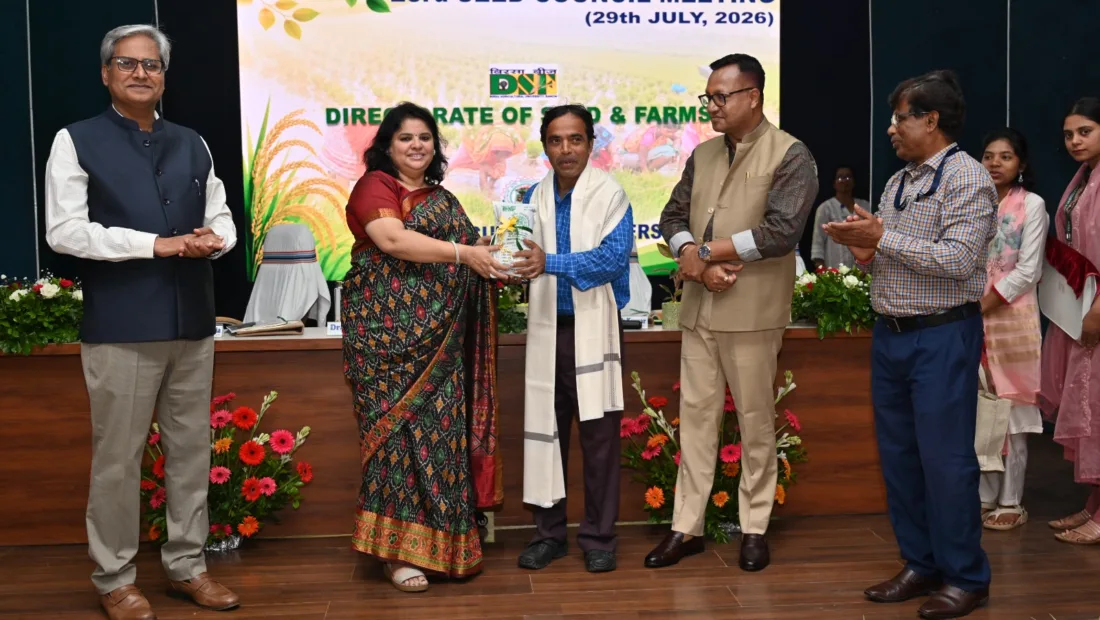
Four progressive farmers from Jharkhand—Mehi Lal Gope (Gomia, Bokaro), Rajesh Prasad Chaudhary (Dhanbad), Chandan Chaudhary (Ranchi) and Vipin Kumar—were felicitated for their contributions to innovative farming.
The programme was conducted by Shashi Singh.
Among those present were Dr Avani Kumar Singh, Head of the ICAR Research Institute, Plandu; Dr M.P. Mandal, Head of the Central Rainfed Upland Rice Research Institute, Hazaribagh; retired BAU Dean Dr Raghav Thakur and Dr S.K. Pal; Director of Research Dr P.K. Singh; Dean Dr D.K. Shahi; Dr Ramesh Kumar, Dr Alok Kumar Pandey, Dr Kaushal Kumar, and Registrar Dr Shailesh Chattopadhyay.