Sona Devi University launches Hindi fortnight 2026
THE JHARKHAND STORY NETWORK Jamshedpur, Sept 16: Ghatshila-based Sona Devi University on Wednesday inaugurated Hindi Fortnight 2026, a 16-day programme aimed at…
THE JHARKHAND STORY NETWORK
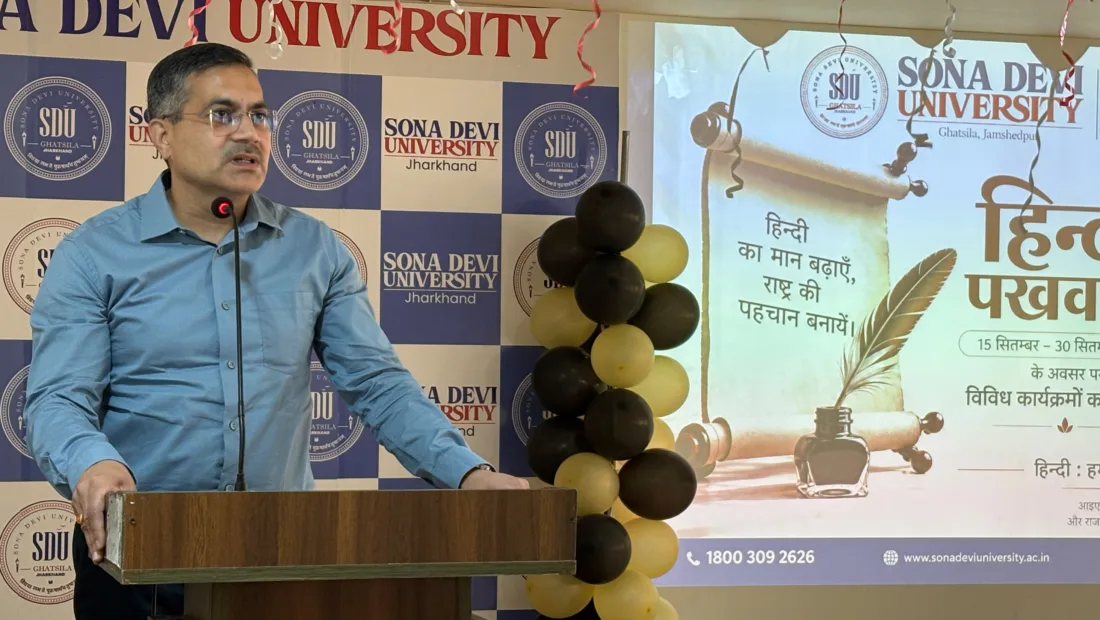
Jamshedpur, Sept 16: Ghatshila-based Sona Devi University on Wednesday inaugurated Hindi Fortnight 2026, a 16-day programme aimed at promoting the use, preservation and wider recognition of Hindi among students and members of the university community.
The fortnight, which will continue till September 30, will feature a series of literary, academic, cultural and creative activities designed to encourage greater interest in Hindi and strengthen its use in education, administration, communication and everyday life.
The inaugural programme was held at the Swami Vivekananda Auditorium in the presence of university officials, heads of departments, faculty members and a large number of students.
The event began with the ceremonial lighting of the lamp and a floral tribute to Goddess Saraswati, followed by a presentation highlighting Hindi and its place in India’s cultural consciousness.
The programme featured speeches, couplet recitations, Hindi songs, poetry and presentations tracing the origin and evolution of the language.
Emphasis on Hindi in education and technology
Pooja Tiwari, head of the Engineering Department, in her introductory address, underlined the importance of taking Hindi beyond literary activities and encouraging its use in education, administration, technology and social interaction.
Dr Kanchan Sinha, Dean of the Faculty of Social Sciences, spoke about the growing global presence of Hindi. She said the language is spoken, understood and studied in several countries and has played an important role in taking Indian literature, culture and traditions to international audiences.
She also presented a poem highlighting the emotional and cultural significance of Hindi.

Nikita Kumari, Assistant Professor in the Sanskrit Department, spoke about the rich linguistic and cultural heritage of Hindi and urged students to use the language more extensively.
Students also made significant contributions to the inaugural programme. Manvi Hemram, a History student, presented verses by Sant Kabir, while another student spoke about the relevance of Hindi in the digital age.
Manish Das, a student of Music, presented a musical performance, while Krishnendu Dutta, head of the Mathematics Department, added a cultural touch with a popular Hindi film song.
Student Saniya Basa stressed that Hindi should not remain merely a subject of study but should become part of everyday communication.
Call for year-round promotion of Hindi
Registrar Nit Nayana called for greater practical use of Hindi throughout the year rather than limiting its promotion to Hindi Day or Hindi Fortnight.
Vice-Chancellor Prof. Braj Mohan Pat Pingua also urged students and teachers to use Hindi in teaching, research, communication and creative activities, while linking the language with digital technology and modern knowledge.
Chancellor Prabhakar Singh called for efforts to enhance the global reach of Hindi. Referring to former Prime Minister Atal Bihari Vajpayee’s address in Hindi at the United Nations, he said such instances demonstrated the potential of Hindi on the international stage.
He also stressed the importance of multilingualism and encouraged students to learn Hindi alongside other Indian and foreign languages.
The Hindi Fortnight will include essay writing, debates, speeches, poetry, handwriting competitions, quizzes and other literary and cultural activities.
The programme aims to provide students with opportunities to engage with Hindi not only as a language of literature but also as a medium of communication, education and creative expression.