Supreme Court divided on law protecting officials from corruption probe
New Delhi, January 13: The Supreme Court on Tuesday delivered a split verdict on the constitutional validity of Section 17A of the…
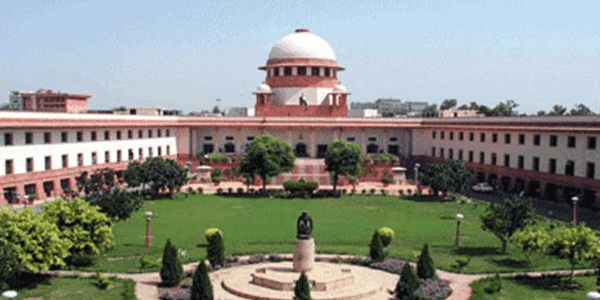
New Delhi, January 13: The Supreme Court on Tuesday delivered a split verdict on the constitutional validity of Section 17A of the Prevention of Corruption Act, which mandates prior government sanction before initiating an investigation against a public servant.
A two-judge bench differed on whether the provision, introduced through the 2018 amendment, violates constitutional principles. The matter has now been referred to the Chief Justice of India for the constitution of a larger bench.

What Section 17A Provides
Section 17A bars any enquiry, inquiry, or investigation against a public servant for decisions taken in an official capacity without prior approval of the competent Central or State authority, except in cases of on-the-spot arrest for bribery.
Justice Nagarathna: Section 17A Unconstitutional
Justice BV Nagarathna held that Section 17A is unconstitutional and must be struck down, observing that it seeks to protect the corrupt rather than honest officials.
“This provision resurrects what was struck down in Vineet Narain and Subramanian Swamy. It forecloses inquiry and shields corruption,” she observed, adding that no prior approval should be required for investigation.
Justice Viswanathan: Read Down, Not Struck Down
Justice KV Viswanathan, however, upheld the provision by reading it down, holding that the decision on sanction must rest with an independent authority such as the Lokpal or Lokayukta, not the executive.

“Striking down Section 17A would be throwing the baby out with the bath water,” he said, warning that lack of protection could lead to policy paralysis.
He ruled that Section 17A is constitutionally valid, subject to the condition that sanction is decided by the Lokpal or Lokayukta.
Balancing Protection and Accountability
Justice Viswanathan stressed the need to balance protection against frivolous and mala fide complaints with the need to maintain probity in public offices.

“The possibility of abuse is no ground to strike down the provision,” he noted, adding that removing Section 17A could create structural imbalances in the anti-corruption framework.
Challenge by CPIL
The verdict arose from a writ petition filed by the Centre for Public Interest Litigation (CPIL) challenging the 2018 amendments to the Prevention of Corruption Act, with Section 17A being the principal target. Judgment was reserved on August 6, 2025.
Arguments by Petitioner
Advocate Prashant Bhushan, appearing for the petitioner, argued that Section 17A reintroduces protections earlier struck down by the Supreme Court.
He relied on Vineet Narain v. Union of India and Subramanian Swamy v. Director, CBI, contending that allowing the executive to approve investigations creates a conflict of interest, especially where ministers are involved.
Centre’s Defence
Solicitor General Tushar Mehta defended the provision, arguing that earlier judgments did not bar all forms of prior approval. He said Section 17A is narrowly tailored to protect bona fide decision-making and prevent vexatious complaints.
He cited Matajog Dobey v. HC Bhari to argue that statutory screening mechanisms are constitutionally permissible and submitted that safeguards exist through reasoned and time-bound approvals.
Court’s Observations During Hearing
The bench raised concerns on both sides. Justice Viswanathan flagged the issue of manifest arbitrariness under Article 14, while Justice Nagarathna noted that not every official decision amounts to corruption and highlighted the need to protect honest officers.
Bhushan countered that adequate safeguards already exist under Sections 17 and 19 of the PC Act, and suggested alternatives like preliminary inquiry under Lalita Kumari, with oversight by courts or the Lokpal.
Next Steps
With the judges divided, the case will now be placed before the Chief Justice of India for reference to an appropriate larger bench.