
Beyond the MTP Act: How the Indian Constitution reimagined reproductive freedom
In Indian constitutional law, few developments have been as quietly transformative as the evolution of reproductive rights. For decades, abortion was treated…

In Indian constitutional law, few developments have been as quietly transformative as the evolution of reproductive rights. For decades, abortion was treated primarily as a medical issue—regulated, conditional, and framed through the language of exceptions. The woman seeking termination often appeared secondary to institutions, doctors, and the state itself. But over time, something fundamental shifted. Courts began asking a different question: What does reproductive choice mean in a constitutional democracy built on dignity and liberty?
That shift altered the entire conversation.
Today, reproductive autonomy in India is no longer understood merely as a statutory permission under the Medical Termination of Pregnancy (MTP) Act. It has increasingly been recognised as part of the constitutional guarantee of life, privacy, dignity, and decisional freedom under Article 21. The implications are profound. The issue is no longer whether the state is willing to “allow” reproductive choices in limited situations. Rather, the central concern is whether the state—or even medical institutions—can legitimately interfere with decisions that belong to the individual alone.
This transformation did not happen overnight. It emerged gradually through judicial interpretation, legislative reform, and difficult constitutional cases involving trauma, minors, fetal abnormalities, and late-term pregnancies. What has emerged is a legal philosophy that places autonomy at the centre of reproductive justice.
Article 21: From Survival to Dignity
The foundation of this transformation lies in Article 21 of the Indian Constitution:
“No person shall be deprived of his life or personal liberty except according to procedure established by law.”

At first glance, the provision appears narrow, almost procedural. Yet Indian constitutional jurisprudence expanded its meaning dramatically over the decades. The Supreme Court repeatedly interpreted “life” to mean more than physical existence. It came to include dignity, privacy, bodily integrity, mental well-being, and the freedom to make intimate personal choices.
That expansion changed the meaning of reproductive rights entirely.
Two judgments were especially significant in this regard: Justice K. S. Puttaswamy v. Union of India and Suchita Srivastava v. Chandigarh Administration.

In Suchita Srivastava, the Court explicitly recognised reproductive choice as a dimension of personal liberty under Article 21. The judgment emphasised that a woman’s right to privacy, dignity, and bodily integrity includes the freedom to decide whether or not to carry a pregnancy to term.
Later, the Puttaswamy privacy judgment deepened this constitutional framework. Privacy was no longer viewed simply as secrecy; it became decisional autonomy—the freedom to make deeply personal life choices without unwarranted state intrusion.
Together, these judgments established three constitutional pillars of reproductive autonomy.
First, the body. The individual possesses bodily integrity. The state cannot compel someone to use their body for purposes they did not choose.
Second, the mind. Mental health holds equal constitutional value as physical health. The anguish caused by an unwanted pregnancy is legally recognised as a serious injury deserving protection.
Third, choice. Decisional autonomy itself became a constitutional right.
These principles fundamentally altered how courts approached abortion law. The issue ceased to be only medical or moral; it became constitutional.
The MTP Act: From Restriction to Expansion
The Medical Termination of Pregnancy Act of 1971 was, in many ways, progressive for its time. It legalised abortion under specified conditions when many countries still criminalised it almost entirely. Yet the law remained heavily doctor-centric. Women did not possess an unrestricted right to terminate pregnancies; instead, medical professionals determined whether legal conditions were satisfied.
The original framework also reflected older social assumptions. Contraceptive failure, for example, was recognized primarily within marriage. Unmarried women occupied a legally uncertain position, revealing how reproductive rights were once tied closely to societal morality.
The 2021 amendments significantly expanded the law.
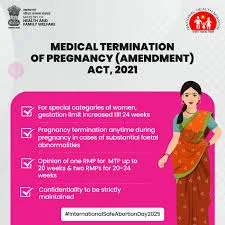
The upper gestational limit increased from 20 to 24 weeks for specific categories of women, including survivors of sexual assault, minors, and other vulnerable groups. More importantly, the amendment extended the ground of contraceptive failure to “any woman or her partner,” effectively removing the marital distinction.
That change carried symbolic weight far beyond technical drafting. It acknowledged something the earlier law had avoided admitting openly: reproductive autonomy belongs to the individual, not to marital status.
The amendment also removed the gestational ceiling altogether in cases involving substantial fetal abnormalities. This reflected a practical and humane recognition that serious anomalies are often detected only in later stages of pregnancy.
Procedurally, the law continued to rely on medical opinions—one Registered Medical Practitioner for pregnancies up to 20 weeks, two practitioners between 20 and 24 weeks, and medical boards for complex late-term cases. But judicial interpretation increasingly clarified that doctors serve an advisory role, not a sovereign one.
That distinction matters enormously.
Decisional Autonomy and the Limits of Medical Authority
One of the most important constitutional developments in recent years has been the Supreme Court’s insistence that reproductive choice belongs ultimately to the woman, not to hospitals or medical boards.
This became especially visible in disputes involving premier institutions like the All India Institute of Medical Sciences. Courts repeatedly clarified that medical boards exist to assess risks and provide expertise, not to substitute their moral judgment for the individual’s choice.
The hierarchy established by the judiciary is relatively clear.
For adults, the woman is the final decision-maker. Consent from husbands, parents, or partners has no legal relevance.
For minors or persons with mental disabilities, guardians provide formal consent, though the individual’s welfare remains central.
Doctors and the state may advise, warn, and explain consequences—but they cannot erase decisional autonomy.
This represents a major philosophical shift away from paternalism. The law increasingly recognises that informed individuals retain the right to make difficult or even risky decisions about their own bodies.
Medical opinion informs choice. It does not replace it.
The Hard Cases: Late-Term Abortions and Constitutional Conflict
The deepest tensions emerge in pregnancies beyond 24 weeks, especially when fetal viability becomes possible. Here, courts confront one of the most emotionally and ethically difficult constitutional questions: how should the law balance maternal autonomy against the potential life of the fetus?
Indian courts have generally leaned toward protecting the rights and dignity of the pregnant individual, particularly in cases involving trauma, severe fetal abnormalities, or minors.
In several late-term cases, the Supreme Court invoked Article 142 of the Constitution—its extraordinary power to do “complete justice.” This allowed the Court to permit terminations even beyond statutory limits when rigid adherence to procedure would produce grave injustice.
One argument frequently raised in such cases is the “adoption alternative”: if the fetus is viable, why not compel continuation of pregnancy and place the child for adoption later?
The Court has largely rejected this reasoning.
Partly, this reflects practical reality. Adoption rates in India remain low, and institutional care often fails to provide stable environments for children.
But the rejection is also constitutional. Forced continuation of pregnancy imposes psychological, emotional, and physical burdens that the state cannot casually dismiss. Carrying an unwanted pregnancy—especially one arising from trauma—is not a temporary inconvenience. It reshapes lives permanently.
In a widely discussed case involving a 15-year-old girl seeking termination at approximately 30 weeks, the Court emphasised that the woman could not be reduced to a vessel subordinate to “the child yet to be born.” Mental trauma and decisional autonomy retained constitutional significance even in advanced stages of pregnancy.
That reasoning reflects a broader judicial recognition: the Constitution protects living individuals, not abstract moral expectations imposed upon them.
Minors, POCSO, and the Burden of Procedure
Cases involving minors introduce another layer of legal complexity because the MTP framework intersects with the Protection of Children from Sexual Offences Act, commonly known as POCSO.
Under POCSO, any sexual activity involving a minor constitutes statutory rape regardless of consent. Consequently, pregnancies involving minors are legally treated as arising from sexual assault.
This creates a difficult procedural structure.
Doctors must report such cases to law enforcement authorities. Guardian consent becomes necessary for medical procedures. If the pregnancy exceeds statutory limits, judicial intervention may also be required.
The process generally unfolds through several stages:
- Medical consultation
- Mandatory reporting under POCSO
- Guardian consent
- Judicial review where required
- Court-directed execution of the procedure
The Supreme Court has repeatedly warned that these procedural obligations must not become barriers to healthcare access. Delays can effectively extinguish constitutional rights because pregnancy advances continuously while institutions deliberate.
This concern explains why courts have occasionally threatened institutions with civil contempt when they failed to comply promptly with judicial timelines. In constitutional matters involving reproductive autonomy, delay itself can become injustice.
From Doctor-Centric Law to Rights-Centric Constitutionalism
Perhaps the most important shift in Indian reproductive jurisprudence is conceptual rather than procedural. The legal system has gradually moved away from a doctor-centric model toward a rights-centric framework.
Earlier, the central question was whether doctors were willing to authorize termination.
Now, the constitutional question increasingly becomes whether the individual’s dignity, privacy, and autonomy are being respected.
This evolution mirrors broader trends within constitutional democracies worldwide, though India’s framework remains uniquely shaped by its own constitutional philosophy. Indian courts frequently ground reproductive rights not only in liberty but also in dignity and constitutional morality.
That language matters because it recognizes that reproductive choices are deeply tied to personhood itself. Decisions about pregnancy influence education, relationships, economic stability, mental health, and social identity. They are not isolated medical events.
The Constitution, therefore, acts as a shield protecting individuals from state coercion in profoundly intimate matters.
The Continuing Tensions
Despite significant progress, the legal framework remains imperfect.
Access to reproductive healthcare still varies dramatically depending on geography, class, institutional capacity, and social stigma. Rural areas frequently lack adequate medical infrastructure. Many women continue to face moral judgment from providers. Procedural delays remain common, particularly in late-term cases requiring court approval.
There is also a persistent tension between statutory law and constitutional interpretation. The MTP Act still relies heavily on medical authorization rather than fully recognizing abortion as a matter of individual choice within specified timelines.
In practice, this means many individuals continue to navigate institutional gatekeeping even when constitutional principles appear settled.
Yet the trajectory of Indian constitutional law is unmistakable. The judiciary has increasingly framed reproductive autonomy as part of the broader architecture of liberty and dignity.
That shift changes not only legal outcomes but constitutional culture itself.
Reproductive Choice as Constitutional Citizenship
At its core, the debate over reproductive autonomy is really about constitutional citizenship. It asks whether individuals are trusted to govern their own bodies and futures—or whether the state, institutions, and social morality retain ultimate authority over intimate decisions.
Indian constitutional jurisprudence increasingly answers in favor of autonomy.
The woman is not merely a subject of medical regulation. She is a constitutional actor possessing dignity, agency, and decisional freedom.
That recognition may be the most important transformation of all.
The law no longer treats reproductive rights as exceptional permissions granted reluctantly by the state. Instead, it increasingly recognizes them as extensions of liberty itself—rooted in privacy, bodily integrity, and the constitutional promise that life means more than survival.
It means the freedom to choose how one’s life will unfold.
(Dr Rachna K Prasad is Assistant Professor of Political Science at Delhi University. She can be contacted at drrachnaprasad24@gmail.com)