
Jharkhand HC bans two-finger test for rape survivors, orders action against violators
Ranchi, June 8: In a significant judgment aimed at protecting the dignity and rights of survivors of sexual violence, the Jharkhand High…
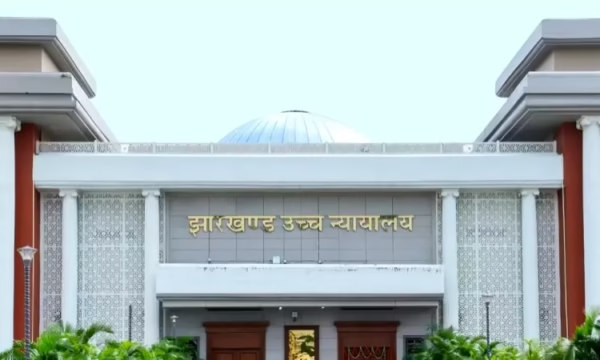
Ranchi, June 8: In a significant judgment aimed at protecting the dignity and rights of survivors of sexual violence, the Jharkhand High Court has directed the State Government to ensure complete prohibition of the controversial two-finger test in all government and private hospitals, holding that the practice violates the privacy, bodily integrity and dignity of rape survivors.
A Division Bench comprising Chief Justice M.S. Sonak and Justice Rajesh Shankar issued the direction while deciding a public interest litigation concerning the rights, protection, rehabilitation and welfare of rape survivors in Jharkhand. The court directed the State Government to issue a binding circular prohibiting the test and warned that any violation would amount to professional misconduct and invite strict action under law.
The judgment was delivered in W.P. (PIL) No. 2253 of 2024, Court on its Own Motion vs State of Jharkhand & Others.
Practice Has No Scientific or Legal Basis
The court referred to the Supreme Court judgment in Lillu @ Rajesh & Another v. State of Haryana (2013), which held that the two-finger test and its interpretation violate the rights of rape survivors to privacy, physical and mental integrity, and dignity. The Supreme Court had also clarified that the results of such a test cannot be used to presume consent.
The Bench further cited the Supreme Court’s decision in State of Jharkhand v. Shailendra Kumar Rai @ Pandav Rai (2022), which ruled that a woman’s previous sexual history is irrelevant in determining consent or adjudicating rape allegations. The judgment noted that Section 53-A of the Indian Evidence Act also makes such evidence legally irrelevant in sexual offence prosecutions.
Observing that the issue is no longer open to debate, the High Court said that medical examinations of sexual assault survivors must be conducted in a dignified manner and strictly in accordance with established legal and medical protocols.

State Directed to Issue Circular
The Bench accepted recommendations made by Amicus Curiae Sumeet Gadodia, who urged the court to direct the Department of Health, Medical Education and Family Welfare to completely prohibit the practice and adopt trauma-informed medical care standards for sexual assault survivors.
Accepting the suggestion, the court directed the State Government to issue a circular banning the two-finger test in all government and private hospitals and medical institutions across Jharkhand. The court also ordered authorities to ensure that medical examinations are conducted with sensitivity and respect for survivors’ rights.
The judgment further noted that the Ministry of Health and Family Welfare had already issued guidelines in 2014 under its protocol on Medico-Legal Care for Survivors/Victims of Sexual Violence, expressly prohibiting the practice. According to the guidelines, the size of the vaginal opening has no bearing on whether sexual violence occurred and should not form part of the medical assessment.

Training for Doctors and Officials
The court endorsed the recommendation that doctors, forensic experts and police officials should undergo regular training and sensitisation programmes to ensure survivor-centric and trauma-informed handling of sexual assault cases.
It observed that any medical professional conducting the prohibited test would be liable for action under applicable professional and disciplinary rules.
Wider Directions for Survivors’ Rights
The direction on the two-finger test forms part of a comprehensive judgment addressing multiple concerns relating to rape survivors and victims of sexual offences. The court issued extensive directions on mandatory registration of Zero FIRs, compensation and rehabilitation, shelter and accommodation facilities, psychological counselling, protection of victims’ identities, free education for children born out of rape, legal awareness programmes and employment support for survivors.
The Bench directed the Director General of Police to ensure strict implementation of Zero FIR provisions under the Bharatiya Nagarik Suraksha Sanhita (BNSS), 2023, and warned of departmental and penal action against police personnel who refuse to register such complaints.
The court also ordered improvements in One-Stop Centres operating across Jharkhand, the constitution of a women-headed monitoring committee, provision of long-term psychological counselling, and formulation of schemes for employment and livelihood assistance for survivors.
Court Emphasises Dignity and Rehabilitation
The High Court observed that rape survivors often face social stigma, isolation and psychological trauma long after criminal proceedings conclude. It stressed that rehabilitation must go beyond financial compensation and include mental health support, education, employment opportunities and, where necessary, relocation and social rehabilitation measures.
The Bench expressed hope that victim-blaming attitudes in society would gradually change and emphasised that survivors must be treated with dignity at every stage of the justice system.