Consent or deception? Jharkhand HC says trial must decide in promise-of-marriage rape case
Ranchi, June 12: The Jharkhand High Court has dismissed a criminal revision petition filed by a Chaibasa resident seeking discharge from charges…
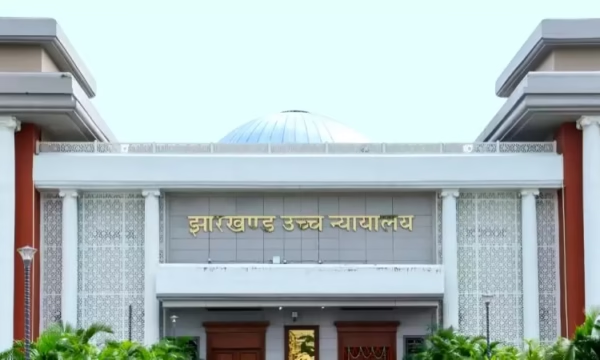
Ranchi, June 12: The Jharkhand High Court has dismissed a criminal revision petition filed by a Chaibasa resident seeking discharge from charges of rape and cheating in a case involving an alleged long-term relationship based on a promise of marriage.
Justice Pradeep Kumar Srivastava, while pronouncing the order on June 12, upheld the April 8, 2022, order of the Special Judge (Fast Track Court), East Singhbhum, which had rejected the accused’s plea for discharge under Section 227 of the Criminal Procedure Code (CrPC).
Nine-Year Relationship at the Centre of Dispute
The case arose from allegations made by the prosecutrix, who claimed that she was in a relationship with the accused, Hitesh Kumar Lohra of Chaibasa, from January 2011 to February 2020.
According to the FIR, the accused allegedly established physical relations with her over the years on the assurance that he would marry her. The woman alleged that whenever she raised the issue of marriage, he postponed it on one pretext or another before ultimately refusing to marry her.
She lodged the complaint after learning that the accused was preparing to marry another woman.
Petitioner Argued Relationship Was Consensual
The petitioner contended before the High Court that both parties were adults and had voluntarily remained in a consensual relationship for nearly nine years.

His counsel argued that there was no material to suggest that the accused had intended to deceive the woman from the beginning. The defence further submitted that there were concerns that the petitioner’s parents would not approve the marriage and that family opposition ultimately led him to marry another woman.
On this basis, the petitioner sought discharge from offences under Sections 376 and 418 of the Indian Penal Code (IPC).
State Opposed Discharge Plea
The State opposed the plea, arguing that at the stage of considering a discharge application, courts are required to examine only whether a prima facie case exists on the basis of materials collected during the investigation.

The prosecution relied on the woman’s statements recorded under Sections 161 and 164 CrPC, asserting that the physical relationship was maintained on the promise of marriage and that the accused repeatedly delayed fulfilling that promise.
No ‘Mini Trial’ at Discharge Stage: High Court
The High Court reiterated the settled legal principle that a court considering a discharge application cannot conduct a detailed examination of evidence or determine the truthfulness of rival claims.
Citing the Supreme Court’s judgment in State of Tamil Nadu vs. N. Suresh Rajan (2014), the court observed that only a prima facie assessment of the prosecution materials is required at that stage.
Prima Facie Case Made Out, Says Court
Justice Srivastava noted that the materials collected during the investigation, including the prosecutrix’s statements, indicated that she had allegedly resisted sexual relations and repeatedly sought marriage, while the accused continued to assure her that he would speak to his family and marry her.
The court observed that the facts, at least prima facie, gave rise to an inference that the accused may have deceived the woman while continuing the relationship.
The order also referred to the woman’s allegation that she was deeply distressed after learning about the accused’s proposed marriage to another woman and had allegedly attempted suicide before filing the case.
Issue of Consent to Be Decided During Trial
The High Court held that the central question—whether the relationship was consensual or whether consent was obtained through a false promise of marriage—can only be determined after evidence is led during trial.
Finding no legal infirmity in the trial court’s order rejecting the discharge application, the High Court dismissed the revision petition.
Key Observation
The court held that at the discharge stage, it is sufficient if the prosecution materials disclose a prima facie case, and disputed questions regarding consent, intention, and alleged deception must be examined during trial.