
Jharkhand Van Samiti promotes lac cultivation beyond traditional areas in Palamu
Daltonganj, June 21: The Medininagar Forest Division in Jharkhand’s Palamu district is successfully promoting lac cultivation in non-traditional locations, demonstrating that the…
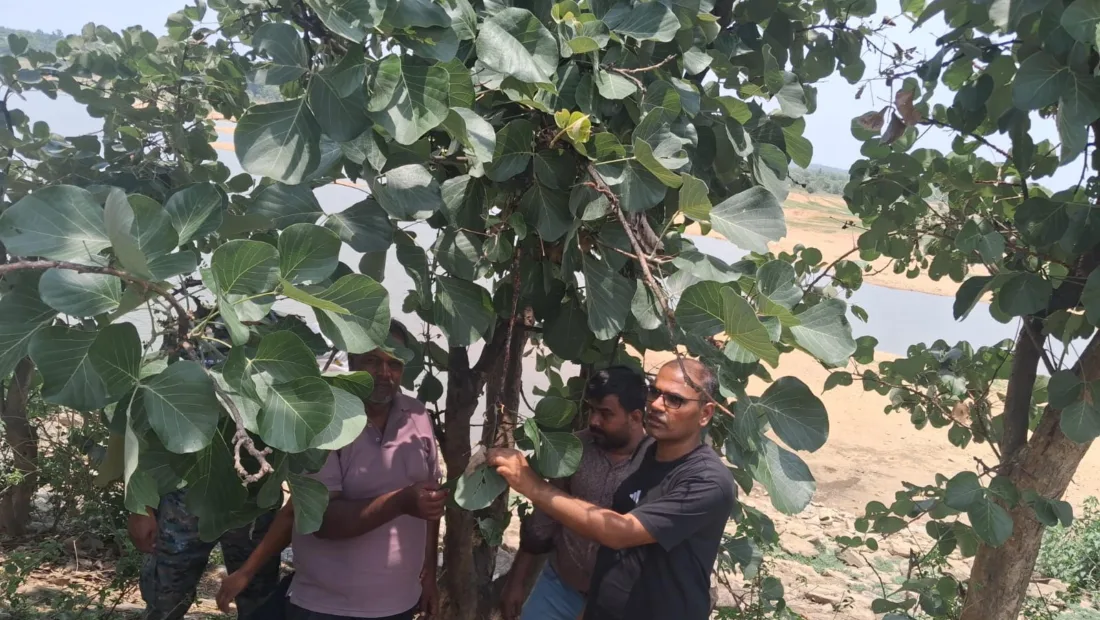
DFO Satyam Kumar of the Medininagar Forest Division inspects an emerging lac brood stick on a Palash tree along a kaccha road in the Manatu Forest Range, Palamu.
Daltonganj, June 21: The Medininagar Forest Division in Jharkhand’s Palamu district is successfully promoting lac cultivation in non-traditional locations, demonstrating that the high-value forest produce can thrive beyond the well-known Kundri Lah Bagaan.
While Kundri Lah Bagaan remains part of a multi-crore state recovery and development plan, forest officials have shown that lac cultivation can be carried out effectively in forest patches and even along roadside areas with minimal risk of theft.
One such example is the Sevti Van Samiti under the Manatu Forest Range, where lac is being cultivated on Palash trees growing beside a busy kaccha road.
DFO Reviews Successful Lac Farming Initiative
Divisional Forest Officer (DFO) Satyam Kumar visited the site on Sunday and inspected lac broodsticks developing on host trees.
He was accompanied by Sevti Van Samiti president Surender Paswan, who is locally known for his involvement in lac cultivation.
Surender credited the success of the initiative to the efforts of the DFO in encouraging forest committees to adopt lac farming in previously overlooked locations.

“DFO Satyam Saheb asked me to promote lac cultivation within the Van Samiti. We started with 300 host trees, and the initiative is growing steadily. Each host tree produces an average of 10 kilograms of lac, which fetches a good price in the market,” Surender told The Jharkhand Story Network.
Alternative Livelihood Opportunity for Villagers
According to Surender, the experiment has demonstrated that lac cultivation need not be limited to Kundri Lah Bagaan.
“Our experience has proved that there are many other locations where lac cultivation can provide a safer and sustainable livelihood option for local communities,” he said.

The initiative is being viewed as a potential source of income generation for villagers while also promoting sustainable use of forest resources.
Lac Farming Offers Strong Profit Potential
Highlighting the economic benefits of lac cultivation, DFO Satyam Kumar said the activity offers attractive returns.
“The input cost is around 40 percent, while nearly 60 per cent remains as profit. More villagers can consider taking up lac cultivation, and the Medininagar Forest Division will provide necessary handholding and support,” he said.
The DFO noted that lac can be cultivated on host trees such as Ber and Kusum, although Palash remains the most preferred species for commercial lac production.
Van Samiti Enforces Strict Protection Measures
The Sevti Van Samiti has also implemented community-based measures to protect forest resources and lac cultivation.
According to Surender, anyone caught stealing forest produce, including lac broodsticks, is fined ₹200. Informants who help detect such offences receive a reward of ₹100.
The committee also regulates the collection of dry and dead wood for domestic fuel. Villagers are allowed to collect such material on one designated day each week, while members of the Van Samiti maintain vigilance over forest resources.