
Jharkhand HC rejects RMC employee’s claim for promotion as assistant law officer
Ranchi, June 24: The Jharkhand High Court has dismissed an appeal filed by a Ranchi Municipal Corporation (RMC) employee seeking promotion to…
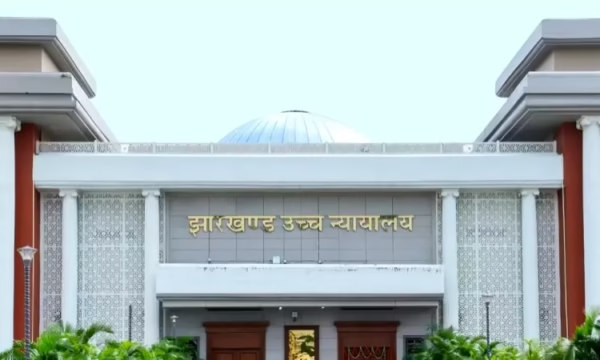
Ranchi, June 24: The Jharkhand High Court has dismissed an appeal filed by a Ranchi Municipal Corporation (RMC) employee seeking promotion to the post of Assistant Law Officer, holding that he was never appointed as a Legal Assistant—the feeder post in the municipal legal cadre—and therefore could not claim promotion to a higher post within that cadre.
A Division Bench comprising Chief Justice M.S. Sonak and Justice Rajesh Shankar upheld the earlier order of a Single Judge, ruling that granting the promotion would amount to an impermissible inter-cadre promotion.
Background of the Dispute
The appellant, Arun Kumar, was appointed on compassionate grounds to a Class-III post in Ranchi Municipal Corporation in May 1996. Shortly after his appointment, he was posted as an Assistant in the Legal Section, where he continued to work for several years. During his service, he obtained an LL.B. degree with the employer’s permission.
The controversy arose after the State Government created posts such as Legal Assistant and Assistant Law Officer in municipal bodies. Subsequently, the Jharkhand Municipal Service Cadre (Amendment) Rules, 2017 introduced a separate Legal Cadre, making the post of Legal Assistant the feeder post for promotion to Assistant Law Officer and, thereafter, Law Officer.
Claiming that he had been functioning in the legal wing for decades and had effectively been treated as a Legal Assistant, Kumar sought promotion to the post of Assistant Law Officer. Ranchi Municipal Corporation forwarded his representation to the Urban Development and Housing Department on multiple occasions, referring to him as a Legal Assistant in official correspondence.
Appellant Relied on Long Service in Legal Section
Before the court, the appellant argued that when he joined service, there was no sanctioned post of Legal Assistant and that he had continuously discharged duties connected with the legal wing. He contended that he was later entrusted with responsibilities including charge of the Legal Section and functions akin to those of a Legal Advisor.

The appellant also relied on the Supreme Court’s decision in Vinod Kumar v. Union of India, arguing that the nature of employment should be determined by actual duties performed over time and not merely by the original appointment order.
State and Municipal Corporation Opposed Promotion
The State Government and Ranchi Municipal Corporation opposed the claim, maintaining that the appellant had never been appointed as a Legal Assistant through any prescribed process. They argued that merely working in the Legal Section could not confer membership of the Legal Cadre or create a right to promotion.
High Court’s Findings
The Division Bench noted that the Legal Cadre was formally created by the 2017 amendment rules and that the post of Legal Assistant was specifically earmarked for direct recruitment of law graduates. The court observed that the appellant neither challenged the rules nor established that he had ever been appointed or absorbed as a Legal Assistant.

The Bench held that references to the appellant as a Legal Assistant in official correspondence could not legally alter his cadre status. It further stated that performing duties connected with a post does not automatically result in appointment to that post.
According to the court, allowing the appellant to be treated as a Legal Assistant without undergoing the prescribed recruitment process would prejudice other eligible candidates entitled to compete for the post through direct recruitment, contrary to the constitutional mandate of equal opportunity under Article 16.
Supreme Court Judgment Distinguished
The High Court also distinguished the Supreme Court’s ruling in Vinod Kumar, noting that the case dealt with regularisation of employees who had continuously served on ex-cadre posts for decades. In contrast, the present case concerned a claim for promotion within a separate legal cadre without a valid appointment to the feeder post.
Holding that a cadre can be changed only in accordance with applicable rules and through an order of a competent authority, the court concluded that the appellant had no legal right to seek promotion as Assistant Law Officer. The appeal was accordingly dismissed.