
Jharkhand HC upholds eviction in Santhal Pargana land dispute, dismisses 14-year-old petition
Ranchi, June 30: The Jharkhand High Court has dismissed a 14-year-old writ petition challenging an eviction order in a land dispute from…
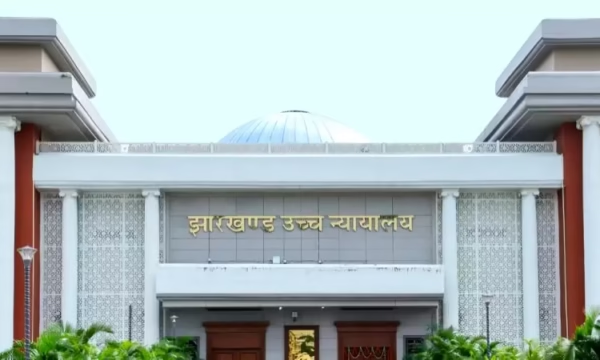
Ranchi, June 30: The Jharkhand High Court has dismissed a 14-year-old writ petition challenging an eviction order in a land dispute from Godda district, holding that the petitioner failed to prove the statutory period of possession required under the Santhal Pargana Tenancy (Supplementary Provisions) Act, 1949. The judgment was delivered by Justice Sanjay Kumar Dwivedi in W.P.(C) No. 3922 of 2012 on June 23, 2026.
The petition was filed by Beni Madhav Jha, who sought to quash the Commissioner’s order dated October 21, 2011, which had restored an earlier eviction order passed by the Sub-Divisional Officer, Godda. The Commissioner had set aside the Deputy Commissioner’s appellate order that had earlier granted relief to the petitioner.

Court examines Kurfanama and possession claim
The dispute centered on agricultural land situated in Mauza Dumaria, Godda, where the petitioner claimed possession on the basis of a Kurfanama allegedly executed in 1941. The respondent, however, asserted rights over the land as the adopted son of the recorded landholder and challenged the petitioner’s claim.
After examining the provisions of the Santhal Pargana Tenancy Act and the applicable Niyamawali, the High Court observed that the Kurfanama relied upon by the petitioner did not satisfy the legal requirements for recognition. The Court noted that the document was neither shown to have been registered nor validated in the manner contemplated under the applicable rules.
The Court further observed that the petitioner had failed to establish continuous possession for the period required under the law after the Act came into force.

Court’s observations
While dismissing the petition, the Court observed:
“It is an admitted position that 12 years period of possession has not been proved by the petitioner.”
The Court also remarked that:

“The said Kurfanama itself appears to be a collusive one.”
Referring to Sections 20 and 42 of the Santhal Pargana Tenancy (Supplementary Provisions) Act, 1949, the Court held that the Deputy Commissioner is empowered to evict persons who have acquired land in contravention of the statutory provisions.
Adoption issue also discussed
The judgment also dealt with the issue of adoption raised by the parties. The Court noted that customary adoption practices in the Santhal Pargana region are recognized under the law and discussed earlier civil litigation concerning the respondent’s adoption. However, the High Court primarily decided the writ petition on the grounds of possession and compliance with the provisions of the Santhal Pargana Tenancy Act.
The Court additionally referred to Supreme Court precedents, including Ram Kisto Mandal v. Dhankisto Mandal and Jyoti Thakur v. Tarakant Jha, while reiterating that the statutory restrictions on the transfer of raiyati land in Santhal Pargana are intended to prevent indirect or collusive transfers that undermine the protective framework of the law.
Concluding that the Commissioner had committed no legal error, the High Court dismissed the writ petition and upheld the Commissioner’s order restoring the eviction. The Court also disposed of the interlocutory application, if any, filed in the matter.