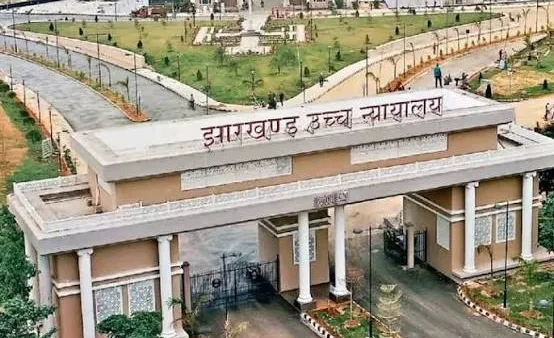
Jharkhand HC quashes punishment against retired REO engineer over fake bitumen invoices
SUMAN K SHRIVASTAVA Ranchi, August 14: The Jharkhand High Court on Friday quashed the departmental punishment imposed on a retired Assistant Engineer…
SUMAN K SHRIVASTAVA
Ranchi, August 14: The Jharkhand High Court on Friday quashed the departmental punishment imposed on a retired Assistant Engineer over allegations that he had countersigned fake bitumen invoices, ruling that the charges were not supported by properly proved evidence.

Justice Deepak Roshan, while allowing two writ petitions filed by Surendra Prasad, held that the departmental inquiry suffered from a fundamental lack of evidence. The court also set aside the orders reducing Prasad’s pay to the minimum of his pay scale and directing recovery of the alleged loss caused to the government.
Case linked to alleged fake bitumen invoices
Prasad, who had served as an Assistant Engineer in the Rural Engineering Organisation, now known as the Rural Works Department, retired in 2019. The case relates to maintenance and repair work on the Bano PWD Road to Pabura-Nimtur-Pangur Path in 2004-05, which was executed through a contractor.
The allegations arose from a CBI investigation ordered by the High Court in connection with a public interest litigation. The CBI subsequently filed a charge sheet against the contractor, Prasad and a Junior Engineer. A departmental proceeding was later initiated against Prasad under Rule 55 of the Civil Services (Classification, Control and Appeal) Rules, 1930.
The departmental inquiry found the charges proved. In October 2015, the disciplinary authority reduced Prasad’s pay to the minimum of his pay scale and ordered proportionate recovery of the alleged loss to the government exchequer.

High Court finds departmental inquiry lacked evidence
A major issue before the High Court was whether the departmental findings could stand when no departmental witness had been examined to prove the disputed invoices, CBI documents, alleged shortage of bitumen, Prasad’s alleged duty to verify the invoices or the financial loss.
The court held that merely placing a charge sheet or investigation report before an inquiry officer does not amount to substantive evidence. Referring to the Supreme Court’s ruling in Roop Singh Negi v. Punjab National Bank, the court said documents collected during an investigation must be properly proved in a disciplinary proceeding.
The court also referred to subsequent Supreme Court judgments emphasising the importance of examining oral witnesses to establish documentary evidence in departmental inquiries.

Countersigning invoices alone not enough, says court
The High Court noted that Prasad’s countersignature on the invoices was not disputed, but said this alone could not establish misconduct.
According to the court, the department needed to prove that Prasad had a specific duty to authenticate the source of the invoices and that he knowingly facilitated a false claim. Neither of these elements was established during the departmental inquiry.
The court also found that allegations concerning empty bitumen drums did not cure the evidentiary shortcomings. No technical measurement, stock verification or accounts evidence was shown to have been produced to establish lesser consumption of bitumen or connect any alleged shortage with Prasad. The road was also reported to be in good condition, with no deficiency in construction quality established.
Earlier criminal acquittal strengthens petitioner’s case
Prasad had also faced a criminal trial based on substantially the same allegations. He was convicted in November 2019, but the High Court acquitted him in appeal on May 15, 2024.
While examining the criminal case, the court found no material to establish that Prasad knew the invoices were forged. It also held that, before 2008, engineers were not required to verify the authenticity or source of such invoices and that the allegation of conspiracy to facilitate payment to the contractor had not been proved.
The High Court clarified that acquittal in a criminal case does not automatically invalidate departmental proceedings because criminal and disciplinary cases follow different standards of proof.
However, it said the present case was different because the criminal and departmental proceedings were based on the same invoices, contractor, road work and allegations of conspiracy and wrongful payment.
Recovery of alleged government loss also quashed
The court also rejected the basis for recovering the alleged financial loss from Prasad.
It noted that there was no evidence establishing the exact quantity of bitumen allegedly not used, its value, the amount recoverable under the contract, Prasad’s individual responsibility or a direct connection between his actions and the alleged loss.
The court further observed that the contractor was responsible for procuring bitumen and that contractual deductions for certain shortages could be recovered from the contractor’s bills.
Court orders consequential benefits within 12 weeks
The High Court held that the departmental finding suffered from a basic lack-of-evidence defect and that the subsequent criminal appellate judgment had undermined the factual foundation of the allegations.
It therefore quashed the two punishment orders, the departmental inquiry report and the January 3, 2025 order rejecting Prasad’s request for reconsideration.
The court directed the authorities to examine the records, quantify the consequential benefits due to Prasad and issue necessary orders within 12 weeks of receiving a copy of the judgment. Both writ petitions were accordingly allowed.