SC unveils landmark victim protection plan to combat human trafficking
New Delhi, May 30: In a landmark judgment aimed at strengthening India’s fight against human trafficking and commercial sexual exploitation, the Supreme…
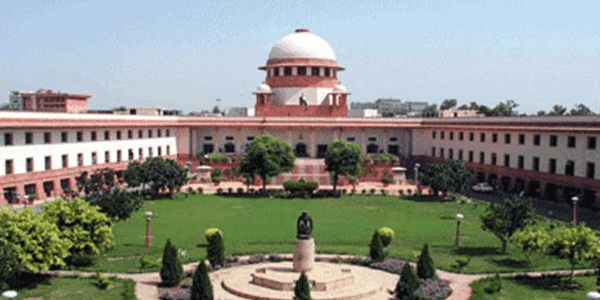
New Delhi, May 30: In a landmark judgment aimed at strengthening India’s fight against human trafficking and commercial sexual exploitation, the Supreme Court on Friday issued an exhaustive set of binding directions for the rescue, protection, rehabilitation and reintegration of trafficking survivors across the country.
A Bench of Justice J.B. Pardiwala and Justice R. Mahadevan, exercising powers under Articles 32 and 142 of the Constitution, unveiled a comprehensive “Victim Protection Plan”, creating a nationwide framework for handling trafficking cases involving women and children.
“It took a pretty long time to prepare this judgment, but we are sure you won’t have to refer to any books henceforth on the subject. This will remain very close to our hearts because it will go a long way in protecting vulnerable young girls and women,” Justice Pardiwala observed while pronouncing the judgment.
Consent Key to Distinguishing Trafficking from Voluntary Sex Work
One of the most significant aspects of the ruling is the Court’s clarification that consent remains the central legal factor distinguishing human trafficking from voluntary adult sex work.
The Court directed police and rescue agencies to conduct a preliminary assessment before initiating coercive action, emphasizing that anti-trafficking laws should not be used to indiscriminately target consenting adults engaged in sex work.
According to the judgment, rescue operations under the Immoral Traffic (Prevention) Act, 1956 must focus on identifying exploitation, coercion, trafficking, abuse and force rather than criminalising vulnerable individuals solely based on their involvement in sex work.

ALSO READ: Jharkhand case spurs SC guidelines: HCs must deliver reserved judgments in 3 months
Trafficking a Direct Assault on Constitutional Dignity
Relying extensively on the Palermo Protocol, the Supreme Court reiterated that trafficking consists of three essential components — the action element, the means element and the exploitation element.
The Bench held that consent becomes legally irrelevant where trafficking is established through force, deception, coercion or abuse of vulnerability.

Describing trafficking as a grave violation of fundamental rights, the Court observed that it amounts to a “direct assault on constitutional dignity” and falls squarely within the prohibition contained in Article 23 of the Constitution.
Rehabilitation Recognised as a Fundamental Right
The Court ruled that rehabilitation is not merely a welfare measure but a constitutional entitlement flowing directly from Article 21, which guarantees the right to life and dignity.
The Victim Protection Plan mandates minimum standards for:
- Safe shelter and accommodation
- Psychological and mental health support
- Vocational training and skill development
- Compensation and financial assistance
- Legal aid and counselling
- Witness protection
- Social reintegration and rehabilitation
The judgment also directs closer coordination among Child Welfare Committees, Anti-Human Trafficking Units, One Stop Centres, Legal Services Authorities and State protection homes.
Special Focus on Children
Recognising the vulnerability of trafficked children, the Court integrated provisions of the Juvenile Justice Act and the POCSO Act into the anti-trafficking framework.
Authorities have been directed to ensure child-sensitive rescue, care and rehabilitation measures, with greater institutional coordination to prevent re-trafficking and exploitation.
No Separate Investigative Agency for Now
While several stakeholders had sought the creation of a specialised agency to investigate organised trafficking networks, the Court declined to issue such a direction.
“We believe whatever statutory framework is there today should suffice,” the Bench observed.
However, it stressed the need for better implementation of existing laws and stronger coordination among agencies already tasked with combating trafficking.
Case Originated from 2004 PIL
The case originated from a Public Interest Litigation filed by Prajwala in 2004, highlighting the growing menace of human trafficking and commercial sexual exploitation of women and children.
Over the past 22 years, the Supreme Court monitored rescue operations, shelter homes, rehabilitation measures, victim identification systems and enforcement mechanisms across several states.
The proceedings revealed serious concerns, including poor conditions in shelter homes, inadequate victim rehabilitation, weak inter-agency coordination and instances of rescued victims being trafficked again.
Compliance Review in Three Months
The Supreme Court has directed the Union Government, States and Union Territories to implement the directions and report compliance. The matter will be taken up again after three months to assess progress.
Legal experts are describing the judgment as one of the most comprehensive anti-trafficking rulings delivered by the Supreme Court, creating a uniform framework for victim protection and rehabilitation across India.