
Jharkhand HC acquits man in 30-year-old murder case, cites unreliable eyewitness
Ranchi, June 25: The Jharkhand High Court has acquitted a man convicted of murder nearly three decades ago, holding that the prosecution…
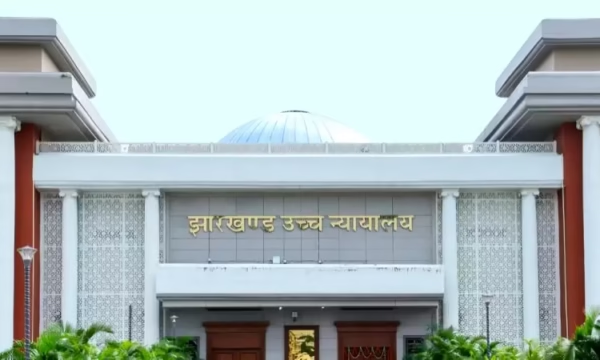
Ranchi, June 25: The Jharkhand High Court has acquitted a man convicted of murder nearly three decades ago, holding that the prosecution failed to prove the charge beyond a reasonable doubt due to unreliable eyewitness testimony and material contradictions in the evidence.
A Division Bench of Justice Sujit Narayan Prasad and Justice Pradeep Kumar Srivastava set aside the conviction of Mansu Manjhi alias Mansa Manjhi, who had been sentenced to life imprisonment by a Bokaro trial court in 2000 for the 1996 murder of Chandmani Manjhian.
Murder linked to witchcraft allegation
According to the prosecution, Chandmani Manjhian was hacked to death in September 1996 after being branded a “witch” by the accused. The FIR alleged that Manjhi attacked the woman with a sharp weapon while another accused assisted him. The co-accused had already been acquitted by the trial court.
Court finds major contradictions
The High Court found that the prosecution’s case rested mainly on the testimony of the deceased’s son, who claimed to be the sole eyewitness.
However, the Bench noted significant contradictions between his testimony and that of his wife regarding how they reached the crime scene and whether he had actually witnessed the assault. The court also pointed to inconsistencies over the weapon allegedly used in the attack.
The judges further observed that several prosecution witnesses had turned hostile, while the investigating officer was not examined during the trial, affecting proof of the place of occurrence.

Benefit of doubt to accused
Holding that the prosecution had failed to establish guilt beyond a reasonable doubt, the court extended the benefit of doubt to the appellant and quashed the conviction and life sentence.
The Bench also reiterated the settled legal principle that while a conviction can be based on the testimony of a solitary eyewitness, such evidence must be wholly reliable and inspire confidence. Since the evidence in the present case did not meet that standard, the appeal was allowed.
The court discharged the appellant from his bail bonds, noting that his sentence had remained suspended during the pendency of the appeal.