Jharkhand News: Latehar administration assures fair prices for mango growers
Daltonganj, June 4: Mango cultivators under the Birsa Harit Gram Yojana in Jharkhand’s Latehar district are hopeful of getting a conducive market…
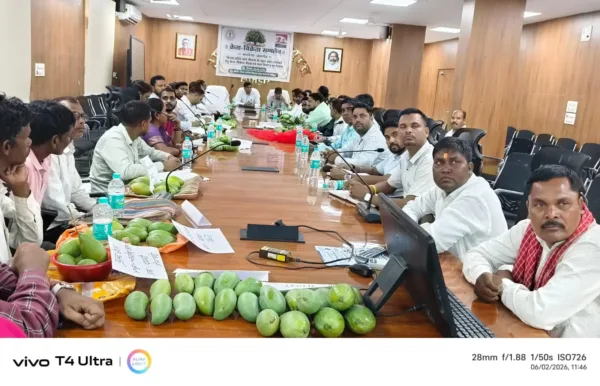
DDC Latehar Syed Reyaz Ahmad chairing a meeting with stakeholders associated with mango cultivation under the Birsa Harit Gram Yojana on Tuesday in Latehar.
Daltonganj, June 4: Mango cultivators under the Birsa Harit Gram Yojana in Jharkhand’s Latehar district are hopeful of getting a conducive market and fair prices for their produce following assurances from the district administration.
However, growers say the situation on the ground remains challenging. Home-grown mangoes, despite being tasty and of good quality, are often less preferred than carton-packed mangoes available in the market.
Adding to their difficulties, recent storms and strong winds have caused extensive damage to mango crops under the Birsa Harit Gram Yojana in Latehar.
Storms Damage Mango Bloom and Fruit Yield
Storms affected mango cultivation in two major ways. First, they damaged the mango bloom or inflorescence, locally known as manjar. A reduction in bloom directly impacts the eventual fruit yield.
Second, strong winds and storms caused ripe and unripe mangoes, locally referred to as Tikola, to fall from trees before harvesting.
Fallen mangoes fetch lower prices in the market and are commonly known as Chotaha (hurt mangoes).

As a result, mango cultivators under the Birsa Harit Gram Yojana are grappling with multiple challenges, including adverse weather, limited local appreciation for their produce, and difficulties in securing fair market prices.
Farmers Report Significant Crop Losses
Weather disturbances have considerably affected mango production, said Kamlesh Oraon, a beneficiary of the Birsa Harit Gram Yojana from Jhano village under Manika block in Latehar district.
“Frequent storms and gales devastated my around 10 quintals of mangoes. I didn’t lose inflorescence or mango bloom (read manjar). I lost unripe mango fruits. It’s a big loss,” said Oraon.

He added:
“Under Birsa Harit Gram Yojana, I went for mango cultivation in 2 acres of my plot of land. I have around 200 mango trees left now. Storm dashed my chances of earnings of the mangoes.”
Under the scheme, one acre of plantation is required to have 112 mango trees.
Oraon said he lost not only unripe mangoes but also a couple of mango trees due to adverse weather conditions. Such losses, he noted, are not uncommon.
Young Orchards Also Affected
Another beneficiary, Shalini Devi of Marang Loiya village under Balumath block, represented by her husband Surender, also spoke about the challenges faced by growers.
“We have raised mango cultivation in just one acre with 112 mango trees. But bad weather took a toll of my 3 mango trees. I am left with just 109 mango trees,” said Surender.
When asked about the impact of recent weather conditions, he said:
“My mango trees are just a year old. There came an enormous mango blossom (read manjar). We shed off the mango blossom ourselves to have a better yield of mangoes in 2027.”
Market Access and Fair Pricing Remain Key Concerns
Apart from weather-related losses, growers say obtaining fair prices for their produce remains a major challenge.
According to Kamlesh Oraon:
“Plucking, packing, transporting and selling mangoes is a day-long tiresome affair. We get very little money for all this labour.”
Market prices vary depending on mango varieties. While Langra and Amrapali mangoes generally fetch better prices, growers allege that buyers often offer lower rates than expected.
Sources said good-quality mangoes are typically sold at ₹50 to ₹60 per kilogram in Latehar markets, but beneficiaries of the scheme often receive lower prices.
Latehar Administration Steps In
Administrative sources said Deputy Development Commissioner (DDC) Latehar Syed Reyaz Ahmad chaired a meeting on Tuesday, June 2, with beneficiaries engaged in mango cultivation under the Birsa Harit Gram Yojana and prospective buyers.
During the meeting, the DDC directed officials of the Jharkhand State Livelihood Promotion Society (JSLPS) and other concerned departments to ensure proper market access and fair prices for mango growers.
A press note issued by Soochna Bhavan, Latehar, stated that the DDC emphasised strengthening market linkages between mango cultivators and buyers to improve returns for farmers.
Experts Stress Need for Better Market Support
James Herunj, Convener of the Jharkhand NREGA Watch, highlighted the importance of fair pricing and market support for growers.
“Mango cultivation under the Birsa Harit Gram Yojana in Latehar is quite a common activity. The need is to have a good and fair market value of it.”
He further said:
“There are beneficiaries in Mahuadanr block in Latehar district who have done a large cultivation of mango trees and are now cross-fingered by the prospects of its sale.”
Herunj also pointed to the growing impact of climate change on agriculture.
“Climate change is affecting agricultural activities globally, and India, or its state Jharkhand, is no exception.”
He called for greater awareness and measures aimed at preserving agricultural produce during extreme weather events.