Grammar of governance: Why India’s three-language formula is more than a political standoff
Every few years, language returns to the centre of India’s political conversation. It is rarely just about words. It is about identity,…

Every few years, language returns to the centre of India’s political conversation. It is rarely just about words. It is about identity, belonging, power, and, increasingly, money.
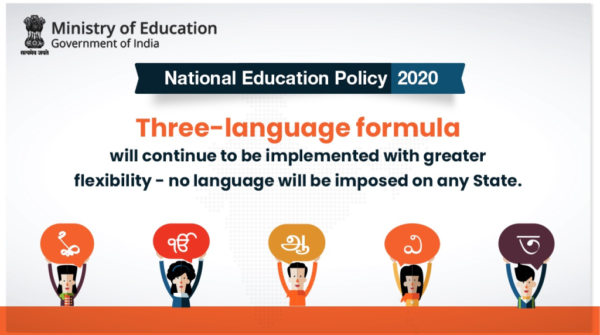
The latest flashpoint revolves around the National Education Policy (NEP) 2020 and its Three-Language Formula (TLF). At first glance, the dispute appears to be a familiar disagreement between the Union government and states such as Tamil Nadu over the role of Hindi in education. Yet the issue has evolved into something far more consequential. Through the Samagra Shiksha scheme, the Centre contributes a significant share of funding for school education. When states refuse to implement aspects of the NEP, including the Three-Language Formula, questions arise about whether educational funding should be tied to policy compliance.

The debate has therefore moved beyond classrooms and into the broader arena of federalism. Who gets to decide what children learn? How much linguistic diversity should a nation encourage? And can educational policy become a tool for shaping national identity?
These questions are not new. They have shadowed India since independence. What is new is the intensity with which they are being asked.
More Than Communication: The Cognitive Argument
For many people, language is simply a means of communication. Educational researchers, however, often see it differently. The ability to function in multiple languages can influence how individuals process information, solve problems, and understand different perspectives.
The NEP 2020 places considerable emphasis on learning in one’s mother tongue or regional language, especially during the foundational years of education. The reasoning is straightforward. Children tend to grasp concepts more effectively when they first encounter them in a language they already understand. Anyone who has struggled to learn a difficult subject through an unfamiliar language can appreciate this point.

Supporters of multilingual education argue that learning several languages does more than improve communication skills. It can enhance memory, strengthen cognitive flexibility, and encourage creative thinking. A child who regularly switches between languages is often exercising mental abilities that go beyond vocabulary or grammar.
Viewed from this perspective, the Three-Language Formula is not merely a cultural policy. It becomes an educational strategy aimed at building stronger learners.
The Persistent Fear of Hindi Imposition
Despite these educational arguments, opposition to the Three-Language Formula remains strong in several states, particularly Tamil Nadu. Much of that resistance stems from historical experience.

Language politics in South India cannot be understood without remembering the anti-Hindi agitations of the twentieth century. For many people, the issue is not simply about learning an additional language. It is about protecting linguistic identity and preventing cultural domination by larger language groups.
Yet a careful reading of the NEP reveals a nuance that is often lost in political debates. The policy does not explicitly require students to learn Hindi. Instead, it states that at least two of the three languages should be Indian languages.
In theory, this allows considerable flexibility. A student in Tamil Nadu could study Tamil, English, and another Indian language such as Kannada, Telugu, or Malayalam. Similarly, students in Hindi-speaking regions are encouraged to learn a language from another part of the country.
Whether this flexibility is sufficient to ease political concerns is another matter. Policies are often judged not only by what they say but by how people expect them to be implemented. In politics, trust can be just as important as wording.
The Unequal Weight of Scripts
One of the most compelling criticisms of the Three-Language Formula is rarely discussed outside academic circles. It concerns scripts rather than languages themselves.
Learning a new language is one challenge. Learning an entirely new writing system is another.
A student in northern India may encounter languages that share significant script similarities. Hindi and Sanskrit, for example, both use Devanagari. This can make language acquisition somewhat easier because the visual framework is already familiar.
The situation is different for many students in the South. A Tamil-speaking child may need to master the Tamil script, the Roman alphabet for English, and the Devanagari script for Hindi or another northern language. Each script operates according to its own logic, symbols, and patterns.
Imagine asking a teenager not only to learn three subjects but also to learn three different ways of writing. The challenge becomes easier to understand.
This concern does not necessarily invalidate the Three-Language Formula. However, it highlights the importance of acknowledging that the burden of implementation is not distributed equally across regions.
Educational Justice or Elite Preference?
Another dimension of the debate receives far less public attention than it deserves. Increasingly, some parents prefer foreign languages such as German, French, Japanese, or Spanish over an additional Indian language.
Their reasoning is understandable. In an interconnected world, proficiency in a foreign language can open educational and professional opportunities. For families with global ambitions, these languages often appear more practical.
Critics of this trend argue that it reflects the priorities of a relatively privileged segment of society. Most students in India are educated within state-supported systems and build their futures within the country’s social and economic framework. For them, familiarity with Indian languages may have greater practical value than early exposure to European languages.
This is where the debate becomes philosophical. Should education primarily prepare students for global mobility, or should it strengthen their connection to local communities and national realities?
The answer is probably not one or the other. Modern societies require both. The challenge lies in balancing them without treating one as inherently superior.
Lessons from Chhattisgarh
Interestingly, some of the most innovative language policies are emerging far from India’s major metropolitan centres.
Chhattisgarh offers a striking example. The state has introduced educational materials in numerous tribal languages and dialects spoken by local communities. The objective is not merely cultural preservation. It is educational inclusion.
Many tribal children enter school speaking languages that are absent from formal instruction. This creates a gap between home and classroom, often contributing to disengagement and higher dropout rates.
By incorporating local languages into early education, Chhattisgarh is attempting to bridge that gap. The initiative suggests that multilingual education can be a tool for social justice rather than a source of political conflict.
Seen through this lens, the Three-Language Formula becomes less about promoting a dominant language and more about creating space for linguistic diversity within formal education.
The Larger Question
The controversy surrounding the Three-Language Formula is ultimately about more than language policy. It reflects competing visions of India’s future.
One vision emphasises national integration and shared cultural understanding. Another prioritises regional autonomy and linguistic self-determination. Both perspectives draw strength from India’s constitutional and historical traditions.
Perhaps the real challenge is not choosing between them but finding a way for them to coexist.
India has never been a nation built on linguistic uniformity. Its strength has often come from its ability to accommodate multiple identities simultaneously. The country’s greatest achievements have emerged not when diversity was suppressed, but when it was woven into a larger national fabric.
As disputes over educational funding and policy implementation continue, the deeper question remains unresolved: can India create an education system that prepares students for a global future while keeping them rooted in their own linguistic and cultural worlds?
The answer will shape not only what languages children learn in school, but also how the world’s most linguistically diverse democracy understands itself in the decades ahead.
(Dr Rachna K Prasad is Assistant Professor of Political Science at the University of Delhi. She can be contacted at drrachnaprasad24@gmail.com)